(c) HOW CANCELLATION DIFFERS FROM TERMINATION FOR CONVENIENCE
(1) Cancellation seems similar to termination for the convenience of the Government. It is a unilateral action taken by the contracting officer when the Government needs to end a contract before it is completed. When a multi-year contract is canceled, the sequence of events is very similar to that following a termination for convenience. This is shown in Figure 5.A. There are significant differences, however, between cancellation and termination for convenience. These differences are included as part of the reason for cancellation or termination and are summarized in Figure 5.B.
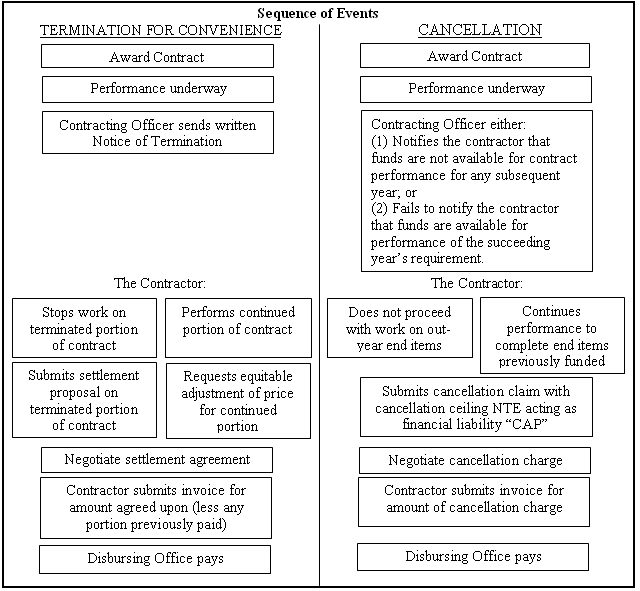
Figure 5.A
Differences Between | ||||
May Apply to: | ||||
Conventional Annual
| Yes | No | ||
Multi-year Contracts | Yes | Yes | ||
When the Action May Be Taken | Anytime during the life of the contract | Anytime, but usually at the start of a fiscal year | ||
What the Action Affects | Either the total contract quantity or a portion of it, as indicated in the termination notice | All subsequent fiscal years' quantities | ||
Reason the Action Is Taken | The Contracting Officer determines a termination is in the Government's interest | Funds are not available for contract performance for the succeeding fiscal year | ||
Authority for the Action | "Termination for Convenience of the Government" (Fixed Price) clause at FAR 52.249-2 | "Cancellation Under Multi-year Contracts" clause at FAR 52.217-2 | ||
Termination Liability | As negotiated | As negotiated but NTE cancellation ceiling "CAP" | ||
Figure 5.B | ||||
(2) As indicated in Figure 5.B, the contracting officer may terminate a contract for convenience at any time during the life of the contract. On the other hand, a multi-year contract may be canceled anytime but usually at the beginning of a fiscal year (i.e., during the time period in which the contracting officer would otherwise obligate funds for the fiscal year's requirement) when appropriations are not received.
(3) Cancellation clauses are discussed in detail in Chapter 12. It is important to note here, however, that the FAR multi-year clause (FAR 52.217-2) recognizes that multi-year contracts can be terminated for default, terminated for convenience, or canceled. Default terminations are based on contractor failure to perform as required. When other circumstances necessitate the early ending of the contract, the contracting officer should use one of the other two tools. Figure 5.B presents the differences between termination for convenience and cancellation. But there can be situations in which it is not absolutely clear which of the two actions should be taken. One example follows. It illustrates the subtleties that can influence a contracting officer's decision to use one tool or the other.
Example Termination and Cancellation Subtleties You have a multi-year contract for 100 flying saucers. You are in FY 3 of the contract, and have fully funded the FY 1, FY 2, and FY 3 requirements. Based on new intelligence, the Air Force recognizes that its flying saucers need to withstand a previously unknown threat. Without significant structural modifications, the flying saucers being acquired under the multi-year contract will not meet user needs. Substantial design and development work will be required before revised specifications will be available. The program manager has three problems: 1. How to modify the saucers already delivered and in use; 2. How to modify the saucers now on the production line; and 3. How to ensure that saucers procured in the future are built to survive the new threat. This discussion will focus on the third problem. The program manager decides to delay acquisition of the FY 4 and FY 5 saucers until the revised specifications are available. The contracting officer must end the multi-year contract in such a way that the FY 3 saucers are delivered, but the FY 4 and FY 5 saucers are not produced. QUESTION: Should the contract be terminated for convenience or canceled? ALTERNATIVE #1: Terminate for convenience. Requirements have changed and it is in the Government's interest to terminate the portion of the contract identified as the FY 4 and FY 5 requirements. ALTERNATIVE #2: Cancel the contract (this would have to be done during the "window of opportunity" between FY 3 and FY 4) since the Air Force decision to not fund FY 4 and FY 5 requirements means that funds are not available for contract performance for the succeeding fiscal year. (Note that the lack of funds is due to an Air Force decision rather than failure of the Congress to appropriate needed funds.) PREFERRED ANSWER: Alternative #1, because it is consistent with statutory and regulatory intent. Cancellation was not intended to be a mechanism for terminating contracts when design changes are needed; it was intended to deal with the situation in which Congress does not appropriate the funds needed to continue the multi-year contract. (Note it is not the "right" answer. The laws and regulations that apply to cancellation are not definitive enough to support the contention that Alternative #2 is wrong.) |