90.1502 PBL Contracting Process and Milestone Review and Approvals.
(a) The PBL acquisition process will consist of four phases: Phase I - Strategic Sourcing; Phase II - Acquisition Planning; Phase III - Solicitation Phase; and Phase IV - Contract Award/Implementation. A graphic representation of the PBL acquisition process is shown below. This section will discuss each aspect of the overall acquisition process.
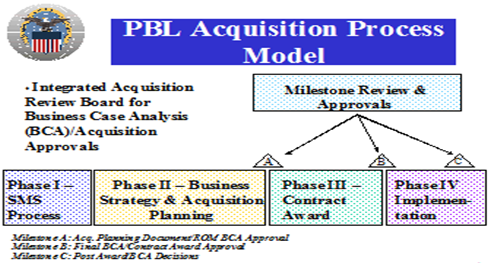
(1) Phase I. Strategic Sourcing - Requirements Development Process.
(i) The Program Manager or Service ICP or DLA Customer Operations personnel have the lead in identifying PBL support candidates and developing requirements. A Performance Based Agreement (PBA) with the customer is the foundation for the overall PBL support strategy, including the objectives and metrics. It is critical that the PBA be re-evaluated to ensure alignment with customer requirements during the lengthy administrative leadtime for PBL procurements.
(ii) The following actions take place during this phase:
(A) Development of PBL objectives
(B) Development of a metrics plan
(C) Identification of candidate NSNs
(D) Analysis of historical information
(E) Completion of market research
(F) Development of small business profile
(G) Identification of core compliancy issues
(2) Phase II. Acquisition Planning
(i) In this phase, the cross functional IPT team is formed, the acquisition strategy is developed, economic feasibility analyzed, and procurement documents are drafted. The acquisition planning phase is characterized by a large amount of collaboration and refinement of documents. The appropriate Supply Chain is responsible for developing a detailed contract schedule or milestone schedule and assigning a lead for tracking actions and progress.
(ii) The IPT is comprised of appropriate process owners with stakeholder coordination and in some cases participation, depending upon the size and complexity of the acquisition. The IPT should function as an integrated team throughout the entire acquisition process to ensure all issues, concerns, and needs are appropriately addressed when pursuing the best value solution. IPT members may include, but should not be limited to technical specialists, engineers, demand planners and supply planners, item managers, quality assurance specialists, contract specialists, legal counsel, contract review and/or pricing analysts, financial analysts, weapon system support managers, supplier relationship managers, customer representatives, industry representatives (for consultation, when appropriate, but not as formal members of the IPT; appropriate measures will be taken to preserve procurement integrity and protect procurement information from improper disclosure to industry representatives), and the Program Manager (or designee). The procurement professional is a key member of the IPT during this phase as they are responsible for drafting procurement documents and communicating with the contractor if the PBL procurement is being developed using the Alpha contracting process.
(iii) When developing the acquisition plan, the integrated team should develop an approach that is appropriate to satisfying the requirement, consistent with sound business practices and based on the degree of risk involved. The team should also establish the managerial approach that will be used to direct and monitor all elements of the acquisition to achieve the goals and objectives of the Program Manager.
(iv) The IPT will develop a Performance Work Statement (PWS), Statement of Objectives (SOO) or Statement of Work (SOW), as appropriate, to satisfy the requirements, goals and objectives of the Program Manager. The IPT will analyze additional requirements to determine which contract performance requirements, if any, should be subject to award, incentive fees, or disincentives.
(v) For PBLs that include support of DLRs, the PBL may include a contractual requirement for the Contractor to partner with a military service maintenance/repair depot for the repair of material. The depot acts as a "sub" to the Contractor, and their relationship is captured in a Commercial Services Agreement. This approach is used to satisfy statutory and DoD requirements for use of maintenance/repair depots. It is the responsibility of the contracting officer to determine the status of items covered by the PBL acquisition and ensure that contract terms and conditions ensure compliance with statutory and DoD requirements (see DoDI 4151.20, Depot Maintenance Core Capabilities Determination Process, and DoDI 4151.21, Public-Private Partnerships for Depot-Level Maintenance, for further information).
(vi) Planned Contract Type. Contract types (e.g. firm fixed price (FFP), fixed price incentive, fixed price with economic price adjustment) most likely to motivate contractors to perform at optimal levels shall be chosen, with consideration given to risk assessment and reasonable risk-sharing by the Government and the contractor(s). If acquiring commercial items under FAR Part 12, use of incentives is permitted as long as the incentive is based on factors other than costs, e.g. performance or delivery. From a contract type perspective, the goal is to award fixed price contracts. This arrangement is most compatible with the affordability objectives of PBL support arrangements, i.e., they should cost the same as traditional support, or less. The fixed price structure also is most compatible with the desire to shift risk and ownership to the contractor. Finally, FFP contracts create inherent incentives for the contractor to reduce costs, reduce transactions and touchtimes; all of which are key to the objective of reducing cost. The inherent risk of entering into fixed price contracts early in a program when firm requirements are relatively unknown may necessitate the use of cost type contracts. As a general rule, legacy systems or components should be supported under firm fixed price PBL contracts. For early lifecycle programs cost type contracts may be considered, until risk factors associated with a fixed price contract type are minimized. Along those lines, PBL strategies will generally have a phased contract approach over the life cycle of the system and its support functions. Cost reimbursement contracts will graduate to fixed price contracts over time. When incentive contracts are used they should include tailored cost reporting to enable appropriate contract management and to facilitate future cost estimating and price analysis.
(vii) Solicitations and contracts targeted to large business should consider impacts on small business and should use creative subcontracting strategies for mitigating any impacts on small businesses. Bundling and consolidation requirements must be considered and addressed.
(viii) The PCO must determine whether the PBL is a supply or services contract. While both may be possible determinations, the DLA preference is for the use of supply contracts for its PBLs. The determination should be based on a thorough review of the statement of work and CLIN structure.
(ix) PBL contracts may be priced in a variety of ways depending on the contractual arrangement, item being supported, performance required by the Government, and a number of other factors. Some simple PBL type arrangements may be priced on an individual item basis (i.e., the contractor is paid by the number of items delivered). As the arrangement moves closer to a full-PBL type contract, unit pricing becomes less preferred. One form of performance based pricing is "power by the hour" where a contractor is paid a set price for each hour that a system operates at or above a specific performance level. PCOs must ensure that a correlation exists between flying hours or other applicable metric and usage in order to use this technique. A second form of performance based pricing is where the contractor is paid a set price for a period of support. DLA's preference is for the pricing strategy for PBL contracts to be at the program level, i.e. based upon the overall savings. This allows the maximum level of flexibility to the contractor in supporting the outcomes required by the metrics.
(x) Also important to note, is that in any pricing scenario unit pricing will likely still be needed to support customer billing requirements, especially important in the working capital environment. The negotiated bill of materials for the PBL would be the likely source for this type information and may be required to be provided to the financial community prior to award and periodically during contract performance. It is important to remember that in these full-PBL type contracts, individual item level pricing must still be included in order to provide for non-PBL support (e.g. for FMS customers or operational needs). Additionally, an evaluation should also be conducted based upon the cost of each segment of the PBL (for example, each ILS element being supported) and in some cases for each item being support (for example, a PBL contract for reparables and consumables). Use of different lines of accounting may be appropriate, and diligence must be paid to ensure the appropriate use of funds. The PCO will provide guidance in development of a CLIN structure to support multiple lines of accounting.
(xi) Exit strategy. A PBL procurement should have an exit strategy that ensures seamless customer support at the end of the PBL contract or the discontinuation of the PBL contract before its final expiration date (for example, due to funding constraints or contractor performance issues). This exit strategy should also be scalable, i.e., outlined in a progressive systematic manner whereby the supplier returns material and data back to government management considering ongoing performance requirements.
(xii) It is important to note that there is no "one size fits all" PBL support strategy. The PM and IPT team will tailor the metrics and scope of the PBL model to the operational requirements of the system or component and ensure that a business model that allows for a win/win relationship with industry is developed.
(xiii) During the acquisition planning process phase the initiative must be evaluated in terms of economic feasibility. The Acquisition Business Case Analysis (BCA) is a document that identifies viable functional alternatives and presents economic and technical arguments for carrying out alternatives over an acquisition life cycle to achieve stated business objectives. The Acquisition BCA is designed to identify costs and benefits that the Defense Logistics Agency (DLA) will realize through the initiation of supply and services acquisition strategies. This analysis will help determine the alternative that is in the Government's best interest. The BCA process compares DLA's current "as-is" (status quo) benefits and costs of doing business to the benefit and costs of viable acquisition alternatives. (Reference DLA Instruction "Acquisition Business Case Analysis").
(3) Phase III. Solicitation Phase
(i) The third phase of PBL development is the solicitation phase. In this phase, acquisition documents are signed, the acquisition is solicited, proposals are developed and audited, negotiations occur, and a final BCA is completed. It is in this phase where the procurement professional plays the largest role - although the other IPT members are also directly involved.
(ii) The Contracting Officer is the Government official authorized to legally negotiate and sign Government contracts. It is the duty of the KO to solicit, evaluate, negotiate, award, and administer the PBL. That said, a successful contract requires ongoing interaction between the contracting officer and the requirements office. The PCO should anticipate difficult and protracted negotiations. In the event that proposals and negotiations indicate that meeting all solicitation requirements may result in a cost higher than the requiring activity anticipates, the issue must be fully coordinated with the customer to ensure that requirements can be met within available or anticipated funding, and for a determination by the requiring activity of whether to decrease or revise requirements. Although the PCO is responsible for the "fair and reasonable" price determination related to PBL cost, the program must be affordable in the eyes of the customer to proceed to award. The financial sponsor may also require a final validation of the cash impact to the working capital funds.
(4) Phase IV. Contract Award/Implementation
(i) In this phase, the contract is awarded and implementation begins. It is critical that prior to award the contract has a contract performance management plan. There is a need to provide enhanced monitoring of contractor performance and to ensure satisfactory administration of PBL acquisitions. Therefore, the contracting officer, in conjunction with the IPT, shall develop a contract performance management plan to delineate responsibilities for specific administration functions. The plan requires coordination within the IPT to include the Customer Support Representatives, the customer, and the Defense Contract Management Agency (DCMA), where appropriate. The plan shall describe the method of managing performance (measuring/tracking metrics and incentives) after award, identify specific roles and functions (include specific responsibilities for the contracting officer, COR (if applicable), ordering officer, DCMA, and program manager).
(ii) Performance Review Board. Consider establishing a performance review board. The board should be comprised of appropriate representatives within the PLFAs as well as customer representatives such as operational command, Service program managers, DCMA, and Service ICP weapon system managers. The purpose of the board is to oversee contract performance. This can be done on a periodic basis such as monthly, quarterly, etc., and may also serve as the review/approval forum for award fees, incentives, and disincentives in accordance with the associated plan. Responsibilities of the board include:
● Assessment of contractor performance against established, measurable standards incorporated into the contract.
● Re-assessment of logistical benefits and costs based on measured/tracked data and analyzed against the documented baseline decision analysis.
● Validating and updating the BCA prior to exercise of each option, upon significant changes during contract performance, and at completion of contract performance.