Positioning Federal Funding for the Longer Term
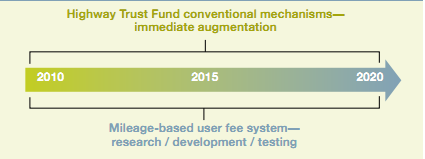
In order to transition to the longer-term solution of funding based on mileage charges, the Commission makes the following recommendations:
• Commence the transition to a new, more direct user charge system as soon as possible and commit to deploying a comprehensive system by 2020. Because of the complexity inherent in transitioning to a new revenue system and the urgency of the need, the Commission recommends that Congress embark immediately on an aggressive research, development, and demonstration (RD&D) program. This would identify and address critical policy questions such as privacy, administrative methods and costs, and the interplay with climate change and other national policy goals, in order to inform Congress as it moves forward. This will require investment in research and technology, including a variety of demonstration programs of mileage-based user fee systems. A research agenda of the nature envisioned would be Pest overseen by a body within the U.S. Department of Transportation that combines technology, policy, tax administration, and systems expertise. It also could benefit greatly from an expert independent advisory committee to help review and advise on funding of RD&D programs, further explore policy issues, and make specific recommendations to Congress.
• Ensure that, once implemented, mileage-based fees and any other charges are set to meet the designated federal share of national surface transportation investment needs, and index these rates to inflation. Simply shifting from one revenue system to another will not solve the under-investment problem if rates are not set at sufficient levels and maintained over time to meet the needs. While a mileage-based direct user fee system is sustainable in the long term, it will suffer at least some of the same consequences as the motor fuel tax system if rates are not set and maintained at adequate levels. For illustrative purposes, the Commission estimates that to meet the base case "Need to Maintain and Improve" annual investment level, the federal VMT fee assessed on all miles driven, regardless of the system where they occur, would be roughly 2.3¢ per mile for cars (equivalent to a 48.4¢ gas tax). To equal the amount raised by the Commission's short-term HTF augmentation recommendations, the fee level for cars would be about 1.4¢ per mile; to match current HTF revenues, about 0.9¢ per mile. These rates would be somewhat higher if assessed only on miles traveled on the federal-aid highway system as opposed to all highway miles. However much revenue Congress decides to raise at the federal level, the Commission believes it is critical to move forward with a VMT fee system.
• As the new mileage-based fee system is put in place, reduce and ultimately eliminate current fuel and other vehicle-related charges as the primary mechanism for funding the surface transportation system, recognizing that the fuel tax may play a role in meeting other important national policy objectives. Once a national VMT fee system is in place, and assuming that rates are set at a sufficient level, the need for the motor fuel-based revenue sources for the HTF will be eliminated. To the extent, however, that surface transportation fuels are subject to a charge in the future to account for their carbon emissions (e.g., a carbon tax or priced through carbon trading), an appropriate portion of those proceeds should be credited to the HTF and dedicated to funding carbon-reducing transportation strategies.
• Establish VMT technology standards and require original equipment vehicle manufacturers to install standardized technology by a date certain that will accommodate the desired 2020 comprehensive implementation. Any technology deployed should be designed to accommodate the full range of potential charge systems in anticipation of the potential for state, local, and private toll roads to piggyback on the national system. These state, local, or private systems should be required to be interoperable with the national VMT standard. Ideally such systems also should incorporate in-vehicle or after-market Global Positioning System (GPS) devices.
| • Initiate an extensive public out- reach effort to create a broad understanding of the current funding problem, the proposed solution, the intended method of implementation, and the anticipated impact on individual system users. This kind of public outreach effort is imperative to a successful transition, for once individuals understand better both the current predicament and the opportunity to achieve positive change, they are more likely to embrace it. With the current indirect system (cents per gallon at the pump, hidden to most consumers in the price of gasoline), most people do not know what they are paying now relative to what is being provided and, more important, what is required to achieve an effective surface transportation system. The direct user charge system being proposed has the potential to make the connections much more evident and thus improve the willingness of individual system users to pay their fair share of the cost. But it will require education and outreach to reach that point. |