Contribution of User Fees to Surface Transportation Investment
The sources of funding for surface transportation and the degree to which revenue mechanisms are tied to system use vary by both level of government and mode.
• Highways: In 2006, some 58 percent of total highway funding came from user fees, which included both tolls and indirect user charges in the form of motor fuel taxes and vehicle-related fees. Historically, direct and indirect user fees have pro- vided the majority of total revenues raised for highway funding. Their share, how- ever, has declined over time, peaking in 1965 at 73.5 percent and subsequently
EXHIBIT 2–5: COMBINED HIGHWAY AND TRANSIT SPENDING AS A PERCENT OF GDP, 1955-2004 |
|
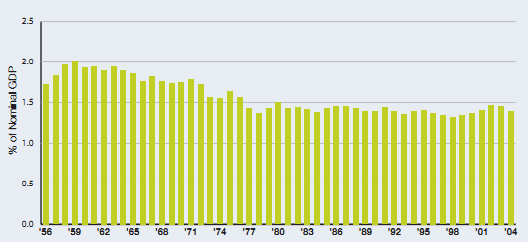
Source: Spending data from CBO Report on Issues and Options in Infrastructure Investment, May 2008. Data on GDP are as reported by the Bureau of Economic Analysis.
settling at around 60 percent (with approximately 5 percent funded from tolls and 55 percent from fuel and vehicle-related charges).10 At the federal level, virtually all highway funding comes from fuel and vehicle-related user charges (the share of federal funding from non-user charges is typically 2-3 percent, mostly from small General Fund programs and interagency transfers). Highway user charges also pro- vide the majority of state funding for highway investment, but they have declined gradually over time from a high of 88 percent in 1965 to 69 percent in 2006.11 At the local level, highway user charges have not been a significant source of revenues (less than 10 percent of the total).12 Instead, funding primarily comes from General Fund allocations, property taxes, sales taxes, and various other taxes and fees. | |||
Overall the trend is away from having users pay the full cost of system use. Indeed, as states and localities have sought to raise more funds they have increasingly looked to sources other than user charges. According to the Government Accountability Office, in the last decade at the state and local level motor fuel taxes went up 2.4 percent, specialized non-user taxes went up 7.5 percent, and property taxes devoted to transportation increased 4.4 percent.13 |
| ||
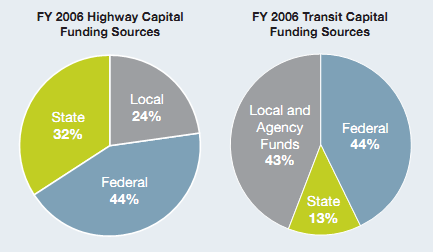
• Transit: In 2006, some 29 percent of total transit funding came from user fees in the form of passenger fares and other local sys- tem-generated revenues. The remainder of transit funding came from federal motor fuel taxes and General Fund allocations (about 18 percent of total funding), state General Fund and tax revenues (20 percent of the total), and local General Fund and tax revenues (33 percent).14 These shares have been relatively consistent over the last two decades.