Highway Trust Fund Revenue Projections
A 2006 report by the Transportation Research Board on the future of the fuel tax concluded that the current highway finance system (including the HTF) will remain viable for some period of time, but it also predicted that motor fuel consumption and associated revenues could decline by 20 percent by 2025.32 Since that report was released, fuel prices have fluctuated wildly and, despite their recent drop, speculation about much higher long-term prices has sharpened concerns about the future viability of the fuel tax in supporting the national surface transportation system. At a minimum, there is currently great uncertainty about the level of HTF funding that could be sustained by current-law tax rates and revenue sources over the next 20-30 years.
Official estimates of HTF revenues have been steadily adjusted downward in recent years. Exhibit 2-15 shows this progression of revenue estimates by comparing the most recent forecast for the Highway Account—the CBO Winter 2009 Baseline Estimates (published in January 2009)—with other estimates prepared during the preceding three years: the receipt assumptions underlying the SAFETEA-LU authorizations (from summer 2005), the FY 2008 and FY 2009 budget estimates (developed in January 2007 and January 2008, respectively), and the estimates contained in the Midsession Review of the FY 2009 Budget (developed in July 2008). As illustrated, estimated Highway Account receipts for the period covering FY 2009-12 dropped 12 percent in nearly three years. And even the most recent estimates may well understate the full decline in revenues that may occur if volatile fuel prices and poor economic performance in the near term worsen this already deteriorating outlook.
In developing its own estimates of future HTF revenues, the Commission evaluated a combination of short- and long-term factors. In the short term, motor fuel price volatility combined with a weak economy could have a considerable negative impact. Exhibit 2-16 shows that VMT growth slowed | |||
| in 2005 and actually began to decline at the end of 2007. In fact, total VMT for the first 10 months of 2008 declined 3.5 percent from the same period a year earlier.33 Moreover, people also are shifting to more fuel-efficient vehicles in response to more volatile fuel prices. | ||
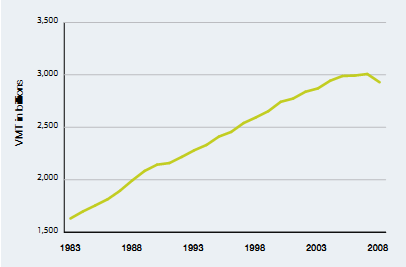
In the long term, confidence in the sustain- ability of existing HTF sources is even weaker than in the short term. Most experts that study fuel consumption and travel trends view the re- cent decline in VMT as a temporary trend and expect travel growth to resume a trajectory of about 1.5-1.8 percent per year for the foresee- able future due to factors such as population growth, economic growth, and land use pat- terns. The primary driver of future uncertainty about HTF revenues is therefore not travel growth but rather average vehicle fuel efficiency. This measure, which has actually dipped slightly over the last 10-15 years, is expected to improve significantly in the future.
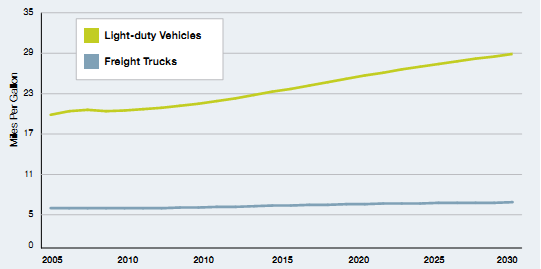
As illustrated in Exhibit 2-17, the U.S. Energy Information Agency estimates that fuel efficiency for all light-duty vehicles will steadily increase, from just over 20 average weighted MPG in 2008 to nearly 29 MPG in 2030. The fuel efficiency of freight trucks also is expected to improve, albeit at a slower rate, from about 6 average weighted MPG in 2008 to nearly 7 MPG in 2030.34 And this assumes that there is no major paradigm shift in vehicle fuel technology (such as affordable electric cars or hybrid heavy-duty trucks), public policy, or public attitudes that encourage people to reduce their long-term travel habits or shift to more efficient vehicles more quickly. Given the growing concern about climate change and fuel price volatility, such changes are quite possible and, in fact, likely. Either separately or in combination, dramatic changes could lead to a much more rapid deterioration in the long-term viability of the current HTF funding sources.
EXHIBIT 2-17: EIA PROJECTED LIGHT-DUTY VEHICLE AND FREIGHT TRUCK MPG |
|
Developing a meaningful long-range year-by-year estimate of HTF revenues poses a significant challenge, in light of the wide range of uncertainty about key factors that influence motor fuel tax receipts. In response to Congress's request for a long-term forecast of HTF revenues under current law, the Commission offers what it considers to be a reasonable range of revenue estimates based on two scenarios:
• A Baseline Forecast that builds on recent official estimates about key variables like VMT growth and vehicle fuel efficiency
• A Conservative Forecast that assumes greater fuel economy improvement and thus lower fuel consumption and reduced revenues
The Baseline Forecast projects current-law HTF net revenues to grow from $36.4 billion in 2008 to $46.2 billion in 2035, reflecting an average annual growth rate of 0.9 percent. Given a conservative estimate of 2 percent annual inflation for future costs (see Box 2-2), federal program purchasing power under this scenario in 2008 dollars would drop to $27.1 billion by 2035, a 25.5 percent decline from 2008.
The Baseline Forecast does not bode well for future federal funding of the nation's surface transportation programs, and yet it may in fact prove overly optimistic. The forecast is based on the assumption that vehicle fleet turnover rates will continue at historical levels and thus severely limit how fast average vehicle fleet efficiency can improve. But what if turnover rates change? What happens to motor fuel consumption if future oil prices, new technologies, and/or concern about climate change lead to a fundamental shift in views about vehicle obsolescence and the public's willingness to invest in high-efficiency or alternative fuel vehicles? In the Commission's opinion, this "change scenario" is well within the realm of real possibility.
The more significant drop in future HTF funding anticipated under a change scenario is difficult to assess. By its nature, this kind of scenario negates the use of existing trend-line methodologies for estimating future motor fuel consumption, and more aggressive forecasts of average vehicle fuel efficiency growth are speculative at best. Given the absence of recognized vehicle efficiency forecasts based on major shifts in vehicle choice, the Commission opted to develop a Conservative Forecast based on future MPG levels that were simply believed to provide reasonable and informative "what if scenarios. Specifically, the Commission evaluated the impact of 2035 MPG levels that are roughly 50 percent higher than the official U.S. Energy Information Agency forecast for light-duty vehicles and 25 percent higher for freight trucks (45 and 9 MPG, respectively). The Commission selected a less aggressive change in freight truck efficiency on the advice of industry experts.35 (See Exhibit 2-18.)
The Conservative Forecast leads to nominal HTF tax receipts by 2035 that are 21.9 percent lower than the Baseline Forecast ($36.1 billion vs. $46.2 billion). This translates into annual federal pro- gram purchasing power by 2035 of just $21.2 billion in 2008 dollars, a 41.8 percent decline from 2008 (compared with a 25.5 percent decline for the same period under the Baseline Forecast). These two revenue forecasts are shown in Exhibit 2-19 and summarized in Exhibit 2-20.
It is important to reiterate that changes in technology, policy, and individual behavior could well lead to even less fuel consumption and even lower HTF revenues over the next 20-30 years.
| Significantly higher fuel prices coupled with faster implementation of new technology enabling widespread use of electric or alternative fuel vehicles would produce much less revenue. | ||||||||||||||||||||||||||||||||||||||||||