OVERVIEW OF FINDINGS AND RECOMMENDATIONS
The Commission has reviewed a wide range of issues and options and, as noted above, has come to the conclusion that federal funding for surface transportation must be transitioned from the current indirect and increasingly ineffective user pay system of federal fuel taxes and vehicle charges to a more robust system that incorporates a more direct user pay structure. A direct user charge system can raise substantially greater revenues and is more sustainable in the long term. Further, the Commission has concluded that the most viable approach in the long run will be a system that is based directly on miles driven (commonly referred to as a vehicle miles traveled (VMT) fee system). This approach also will strengthen state and local governments' ability to assess charges that better capture actual costs with their own pricing systems where appropriate (e.g., based on time of day, location, vehicle weight, and fuel economy). The Commission recognizes, however, that such a transition cannot be made overnight and that the immediate needs are simply too critical to wait. The Commission therefore recommends a multi- pronged approach to meet both short-term and longer-term challenges.
MILEAGE-BASED FEE SYSTEM: |
Highway Trust Fund conventional mechanisms-
Mileage-based user fee system- |
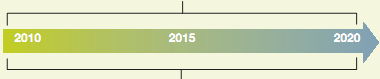
• Protect and Enhance the Highway Trust Fund (HTF). The Highway Trust Fund has served us well and should be continued as the foundation for our user-based surface transportation funding system to ensure ongoing accountability.
• Transition to a New Revenue System. Recognizing the problems inherent in the current fuel tax-based system, particularly over the longer term, the Commission recommends shifting to a system based on more direct user charges, using measures of miles traveled as the basis. This transition process should commence immediately and have as its goal deployment of a comprehensive new system by 2020.
• Address the Near-Term Federal Funding Crisis. Meanwhile, to address the immediate and critical investment gap, the Commission recommends one-time increases in and indexing of existing Highway Trust Fund revenue sources. These adjustments should be made in conjunction with the upcoming reauthorization of the federal surface transportation program.
• Facilitate State and Local Investment. Concurrently, the federal government should put in place policies that allow and encourage state and local governments to raise additional funds from targeted user-based mechanisms such as tolling and pricing. While other funding mechanisms undoubtedly are important at the state and local level, federal policy does not generally play a significant role with those.
Given the complexity inherent in transitioning to a new revenue system and the urgency of the need, the Commission recommends that Congress embark immediately on an aggressive research, development, and demonstration (RD&D) program. This would identify critical policy questions, gather information on such questions, and move forward with the transition based on this work.
As background to the specific policy recommendations, the Commission arrived at a number of critical findings.
• The current federal surface transportation funding structure that relies primarily on taxes imposed on petroleum-derived vehicle fuels is not sustainable in the long term and may erode more quickly than previously thought. Emerging energy and environmental policies and new vehicle technology (relating both to fuel efficiency and alternative fuels) are already driving down petroleum consumption by individed highway system users, and the rate of reduction is likely to accelerate over time.
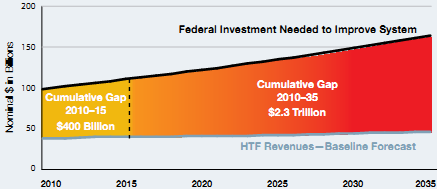
• At current levels of taxation, the existing structure is unable to generate sufficient revenues to meet the federal share of demonstrated national system needs-and the gap between revenues and needs will continue to widen. (See Exhibit 8-1.)
• In the current environment, where needs far outstrip resources, state and local policy makers are struggling to meet the most basic requirements for simply maintaining the existing system. They are particularly challenged when assembling funding for key improvements to the system, especially for the largest and most complicated capital improvements to the national network.
• Among the key roles the federal government can play is to offer new incentives to help state and local officials overcome friction points in using new funding approaches, including but not limited to the option to charge tolls to construct new highway capacity in metropolitan areas and other types of direct user fees to the extent that states and localities find it appropriate and effective to use those strategies to raise their non-federal shares. Offering the necessary incentives, grants, and policy support will require substantial federal resources. If conducted in conjunction with increases in current HTF revenue sources, however, this can be accomplished without taking away resources from the core federal program and will enable existing federal HTF funds to go farther than they would otherwise.
• Properly structured financing techniques, including partnerships with the private sector, can provide important help by leveraging future revenue streams to meet upfront capital investment needs. Such financing techniques, however, should not be expected to be a substitute for solving the true underlying problem: the need for immediate and significant revenue increases to begin to reverse the surface transportation investment deficit that has built up over at least the last few decades. Further, substituting financing for increased revenues may exacerbate the problem by masking the underlying funding deficit.
• A funding and finance framework that relies on more direct forms of "user pay" charges such as a VMT fee system is the consensus choice for the future. The Commission's extensive investigation into alternative funding approaches has proved to its satisfaction that a VMT-based system is the best available option for the next-generation federal revenue system. A properly calibrated VMT fee system could:
• Make it more feasible to provide sufficient resources to fund a cohesive and comprehensive national surface transportation program, including necessary and important cross-subsidies for certain areas or user groups, such as rural highways, public transportation, or other critical investments
• Be structured to more equitably allocate real system costs to those users placing the most demands on the system based on the belief that system use, not solely fuel use, is what affects the quality of our transportation system
• Help optimize use of existing infrastructure and result in relatively lower overall capital investment needs
• Avoid dependence on consumption of petroleum-derived fuels for its very existence, which is increasingly important given current and emerging energy and environmental goals that will drive increases in fuel efficiency
In sum, if implemented correctly, a VMT-based system would be most consistent with the Commission's guiding principles for a new federal funding approach, as outlined earlier.
The individual policy recommendations presented in this chapter are structured to respond to the Commission's key findings and to achieve the required fundamental paradigm shift with the least disruption to current system users, recognizing that no transition is possible without some challenges or short-term dislocations.
The Commission's recommendations are organized in four broad categories:
• Federal Revenue Strategy Recommendations-including short-term and long-term recommendations to raise money for the federal portion of the national surface transportation system investment needs
• Recommendations on Federal Policy Drivers to Facilitate Non-Federal Investnent (including for states' share of costs of the federal system and portions of the transportation system beyond the federal purview)-such as tolling provisions as well as finance and tax policy recommendations
• Research, Development, and Demonstration Recommendations-to support the broader recommendations and, in particular, to support the transition that is envisioned while minimizing disruptions to the system and its users
• Additional Recommendations Related to Resource Allocation-including a few observations about the allocation of federal resources that are closely related to the Commission's funding and finance-related recommendations
EXHIBIT 8-1: A LARGE AND WIDENING GAP BETWEEN FEDERAL REVENUES AND INVESTMENT NEEDS, 2010-35 (in nominal dollars) |
|