II. RECOMMENDATIONS ON FEDERAL POLICY DRIVERS TO FACILITATE NON-FEDERAL INVESTMENT
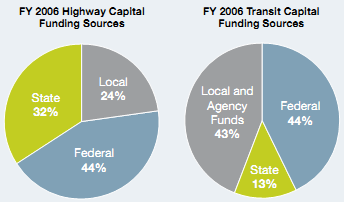
The nature of the intergovernmental funding partnership for surface transportation in the United States means that restoring the capacity of the federal government to meet needs designated as "federal responsibility" is not enough. As of 2006, state and local governments funded over 55 percent of both transit capital and highway capital through state-level motor fuel taxes, a host of vehicle-related fees and charges, property taxes, sales taxes, general revenues, transit fares, and-to a modest though increasing extent-through tolling, either directly by state and local tolling authorities or in a handful of cases by the private sector.
(See Exhibit 8-6.) This does not include additional system operations and maintenance costs borne primarily by state and local jurisdictions. Any national solution therefore must address not only the sustainability of the federal program but also how to enhance the ability of state and local governments to meet their share of the overall funding responsibility.
In determining what the federal government can and should do to facilitate non-federal surface transportation infrastructure investment, the Commission recognizes several important realities:
• Federal policy currently allocates HTF revenues to the states based largely on formula-driven apportionments, without specific adjustment for the quality or efficiency of outcomes.
• State and local officials, not federal officials, play the lead role in deciding what capacity enhancements to build, what role direct user fees (e.g., tolls and transit fares) will play to help fund such capacity, and the allocation of tax revenues to specific projects-subject to federal guidelines, restrictions, and specific discretionary funding programs.
• Making the decision to charge direct user fees for new capacity and managing the financing complexities of converting that future revenue stream into the maximum upfront capital for construction have presented and will continue to present daunting challenges-both politically and practically-for state and local officials.
• Overcoming these challenges need not lead to a restructuring of the model whereby state and local policy makers make the key decisions in project development and finance, but success will require new tools and closer consultation among federal, state, and local officials.
Given these realities, while the previous recommendations focused on areas of direct federal funding responsibility (and considered the possible negative effect on the states of federal funding sources), this section offers recommendations related to federal policies or programs that can increase the options available to states and localities for funding their non-federal share. The recommendations focus, in part, on financial incentives, which historically have been useful tools to help state and local officials overcome inherent obstacles to implementing funding and finance innovations in a range of policy areas, including transportation.
Examples of past successes with federal financial incentives include:
• A variety of funding programs that provided states and localities with incentives to demonstrate the application of pricing in highly urbanized transportation networks
• Federal credit programs such as the Transportation Infrastructure Finance and Innovation Act of 1998 (TIFIA) program-which, among other finance-related objectives, provides incentives for states to use new non-federal revenue streams and attract private and other forms of non-federal investment for major projects
• The State Infrastructure Bank (SIB) program, giving states an incentive to create in-house revolving loan programs to aid local and regional projects
The Commission's recommendations related to facilitating state and local investment include, Put are not limited to, new financial incentive programs in three broad subcategories:
• Federal policies and programs related to tolling and other direct user fee funding initiatives Federal financing assistance programs, financing incentives, and tax policy
• Federal policies and programs related to private-sector financial participation
EXHIBIT 8-6: SHARE OF CAPITAL FUNDING, BY LEVEL OF GOVERNMENT |
|