SUMMARY
1 Although 90 per cent of patient contact with the National Health Service (NHS) is for primary care services - the care received upon first contact with the healthcare system - investment in primary care historically has been inadequate and piecemeal. Most public sector health investment has been channelled into hospitals. As a result the quality of primary care buildings is often poor. To address these issues, the Department of Health (the Department) announced in 2000 a major new initiative, - the establishment of NHS Local Improvement Finance Trusts (LIFT) to develop primary and social care services1 and facilities in England.
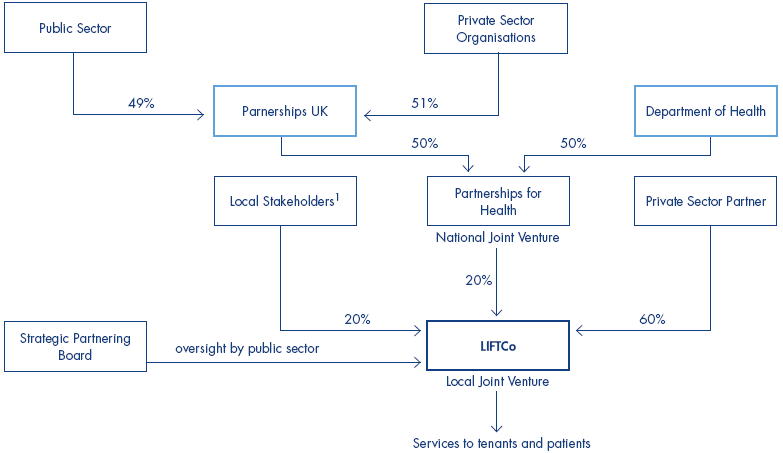
2 LIFT is innovative in that it is based on long term joint ventures at national and local level. The national joint venture, Partnerships for Health, is between the Department and Partnerships UK.2 The local joint venture company (the LIFTCo) is owned by representatives of the local health economy, Partnerships for Health and a private sector partner (Figure 1). As individual primary care developments tend to be small scale - averaging around £5 million - LIFT takes a "batched" approach and promotes a standardised procurement process. Project priorities are determined in the context of a local strategic plan, developed by a Strategic Partnering Board, comprising representatives of stakeholders from the local health economy.
3 This structure fits with Government policy to use the private sector where feasible to increase healthcare investment. The structure also has strategic advantages over other forms of procurement. It allows long term investment projects to be prioritised according to local needs and developed using private sector expertise. In addition it means local and national priorities can be sustained at the operational level. The new approach cannot, of course, guarantee success, which will be dependent on the effectiveness of the local partnering arrangements.
1 | Structure of a LIFT Public Private Partnership |
Source: National Audit Office | |
NOTE 1 Primary Care Trusts, Local Authorities, General Practioners who wish to take a shareholding. | |
4 42 local schemes across England had been approved by the Department by August 2002, with a total capital value (for initial buildings) of £711 million. A further nine schemes were announced in November 2004. Initial schemes were focused around deprived inner city areas, where health needs are greatest and prevailing conditions are poorest. The Department made start up funding of £195 million available, with the aim of levering in a total of up to £1 billion of private investment between 2000 and 2010. This investment in primary care is unprecedented in the history of the NHS.
5 At the local level, LIFT is led by Primary Care Trusts which set up a project board to:
■ Develop a Strategic Service Development Plan - defining local health needs and prioritising development of services and premises. This enables a focus on better service delivery and outcomes and not just new premises;
■ Attract interest from potential private sector bidders and carry out a competitive procurement process for a sample of projects; and
■ Negotiate terms with a preferred bidder for the initial batch of projects and establish the basis for which projects over the next 20 years are undertaken.
6 Unlike PFI deals, LIFT deals are based on the local LIFTCo owning the premises which it builds and refurbishes. Income comes from leasing space to Primary Care Trusts, healthcare professionals (including General Practitioners (GPs), pharmacists and dentists) and other interested social care or voluntary sector tenants.
7 As at early 2005, LIFT is still at an early stage. Most LIFTCos are operational but few buildings are open. The initial buildings commissioned are likely to be only a fraction of the developments planned under the initiative. Most of the developments to date have been well received by local stakeholders, although some proposals have provoked local opposition. Similar procurement models are already being used in other sectors - notably in secondary education. There is therefore a lot of interest in the set-up of LIFT, its ongoing value for money and its accountability arrangements.
8 This report examines whether LIFT will support improved primary and social care services that meet local needs while providing value for money. It focuses on the lessons learned and best practice recommendations of benefit to future LIFT schemes and similar procurement models. Evidence at the local level comes largely from case study material from the first six schemes completed: East London and the City, Barnsley, Sandwell, East Lancashire, Barking and Havering and Ashton, Leigh and Wigan.
9 We conclude that it looks as if LIFT will work - at national level LIFT is an attractive way of securing improvements in primary and social care. The local LIFT schemes we have examined appear to be effective and offer value for money. Local management frameworks need to be strengthened.
_____________________________________________________________________
1 Social care is the professional provision of care, support and welfare for dependent or vulnerable groups or individuals.
2 Partnerships UK, is itself a joint venture between HM Treasury, Scottish ministers and the Private Sector, HM Treasury having a substantial minority shareholding. Partnerships UK work exclusively for the public sector to improve delivery of Public Private Partnerships