Advisory costs have decreased as learning curves have been overcome
1.18 Our survey of project directors showed that the overall usefulness of advice provided to local schemes from Partnerships for Health, financial advisors and legal advisors was moderately or highly rated by 88 per cent, 98 per cent and 98 per cent of respondents respectively. Key concerns about the advice supplied, identified by our case study areas, were that there was little continuity in the individuals allocated to schemes, obtaining a decision was often a slow process and the level of fees paid were greater than expected. These problems were due in part to LIFT being a new programme that was expanded more quickly than expected initially. Partnerships for Health therefore deployed first wave advisors on subsequent schemes to spread existing knowledge. Difficult issues encountered by individual schemes were resolved at a national level to ensure a correct precedent was set.
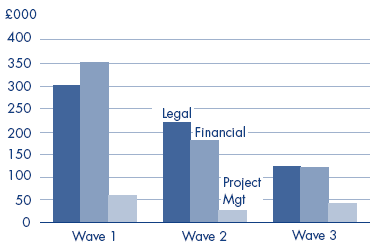
1.19 Although LIFT was a new initiative with no comparators, Partnerships for Health set initial local budgets for financial and legal advice and an overall budget for central advisory costs. The local budgets were revised and became more accurate for each subsequent wave of LIFT schemes. Public sector advisory costs reached £17.5 million in September 2004, which represents 4 per cent of total capital expenditure on LIFT. This appears reasonable in comparison to average advisory costs of around 4 per cent of the capital value of projects in NHS PFI deals, particularly as LIFT schemes have much smaller capital values than most PFI schemes and advisory costs within the LIFT lifecycle are front loaded - the bulk of advisory costs being incurred prior to completion of negotiations to establish the joint venture.10 Although the public sector found the initial costs involved in setting up LIFT expensive, costs reduce in the longer term as learning curves for both the advisors and the public sector are overcome with time. This is already borne out by the reduction of advisory costs per scheme for each successive wave shown in Figure 5.
|
5 |
Advisor's costs fell across waves as standard documentation was developed |
|
|
|
|
Source: National Audit Office analysis of Partnerships for Health advisory costs report |
|
1.20 Partnerships for Health undertook regular monitoring against overall budgets, but detailed monitoring of spend for each scheme was carried out locally. Overall review of local advisory costs started in December 2003, largely because Partnerships for Health noticed that local schemes were not always taking advantage of reduced rates which they had negotiated centrally with advisors - to be triggered once an agreed volume of work had been billed. Although Partnerships for Health undertook some informal analysis of the cost effectiveness of advisory firms and their employees, there is no formal process for capturing feedback from the local project teams or a systematic approach to assessment.
_____________________________________________________________________
10 The Committee of Public Accounts - 19th report 2002-03 "The PFI contract for the redevelopment of West Middlesex University Hospital HC 155 2002-03" gives costs varying between 1 and 8 per cent of the capital value of NHS PFI projects with the average being 3.7 per cent. These costs were broadly consistent with costs which the Ministry of Defence told the National Audit Office they expected to incur on major projects.