Evaluation processes could usefully be improved
1.24 The Department's early thinking was that the six first wave projects, launched in February 2001, would act as pathfinders. A policy decision to speed up LIFT and enhance the contribution to NHS Plan targets precluded using the first wave schemes as genuine pathfinders. Instead the second and third waves of schemes were initiated in February and August 2002, before any first wave schemes established their LIFTCo. Although Partnerships for Health took steps to disseminate lessons as they were learned, inevitably common problems were replicated and some schemes had to resolve issues as they arose because they had not had a chance to learn from the first schemes. For example, several schemes wrestled with the legal issues around whether the Primary Care Trusts would have to take the headlease on a building and sub-let to tenants or whether each tenant would take a direct lease. Ultimately, this was resolved - Primary Care Trusts have found it simpler to take headleases.
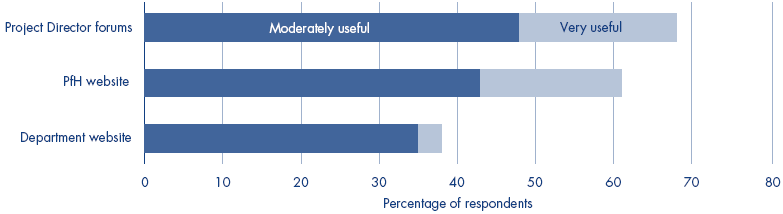
1.25 Sharing of best practice and learning of lessons happened at a national level. Partnerships for Health and the Department disseminated emerging lessons to schemes through a variety of initiatives, including conferences, websites and project director forums. We surveyed project directors across the 42 initial schemes and found that they thought generally that these resources had been useful (see Figure 6). Local networking was also useful between schemes in the same region or with the same private sector partner.
1.26 There is clearly scope for the Department and Partnerships for Health to improve the learning framework if best practice is to be further disseminated, into the fourth wave and into non-LIFT areas who wish to use the model independently. Partnerships for Health intend to expand their procurement support and investor role in LIFT into organisational development. They recognise the need to develop expertise, which they do not currently have, to do this. Early developments include a series of workshops for participants in LIFT.11 Partnerships for Health have also established a discussion forum on their website to allow exchange of experience across the country.
1.27 It is important that the Department evaluates LIFT in comparison to other available procurement routes. The Department encourages local areas to consider LIFT as a procurement route, but recognises that LIFT is not the only way of securing improvement in primary care, and is still committed to provide central funding for new premises and small scale redevelopment. Formal and ongoing analysis of the advantages and disadvantages of LIFT in comparison to other procurement mechanisms needs to be undertaken to enable local areas to decide which route to take. A framework, perhaps in the form of a decision tree, to help local areas understand the different routes and sources of funding for improvement would also be useful.
6 | The majority of Project Directors found available information useful |
Source: National Audit Office survey of Project Directors | |
______________________________________________________________________
11 Non executives of LIFTCos, Chairs of Strategic Partnering Boards and service delivery planners.