The LIFT model facilitates the achievement of value for money
2.19 The value for money of a LIFT project needs to be judged on the basis of whole life costs (taking operation, life cycle, replacement and maintenance costs into account as well as construction costs) and how well it meets objectives, including local health priorities, delivery to time and budget, the quality of the building in structural and functional terms and flexibility of use over time.
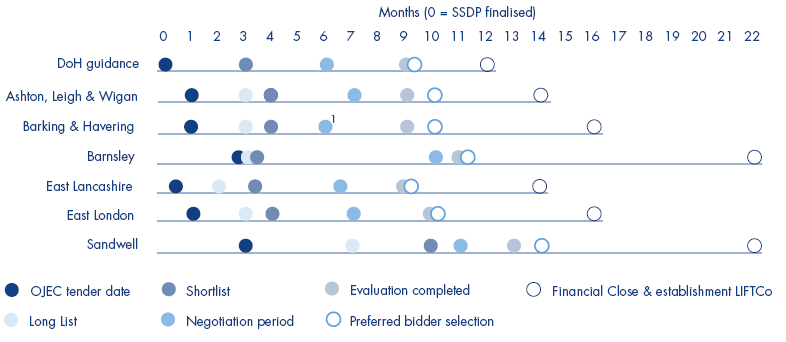
7 | None of the LIFT schemes were able to meet the Department's timetable |
Source: Department of Health and individual LIFT schemes | |
NOTE 1 Estimated date. | |
2.20 Appraising value for money is not, therefore, straightforward or easy. The main advantages of LIFT over other forms of procurement are:
i. projects are prioritised and developed in light of local strategic priorities; and
ii. private sector expertise is brought in and frees up the public sector to concentrate on core health activity.
This should lead to better health outcomes - which may be very difficult to quantify. A judgement needs to be made on the value of unquantifiable health outcomes. Whole life costs over the length of the partnership are inevitably uncertain. The cheapest option may not, therefore, be the option that offers best value for money.
2.21 In practice value for money has largely been demonstrated by there being a competitive procurement and review of (i) proposed rental costs by the District Valuer13 and (ii) the funding terms. Any adverse changes between selection of preferred bidder and completion of negotiations are also scrutinised carefully. A series of measures and checks have also been built into the procurement process to try to secure longer term value for money. The affordability of the lease plus charges has also been an important issue and has driven the initial financial structures. As debt is cheaper than equity, the public sector has sought to keep equity to around 10 per cent of the financing.
Barking and Havering selected Primaria as their private sector partner, even though they were ranked second out of three shortlisted bidders on the basis of their cost proposals. The higher lease payment was still affordable, but Primaria were chosen because of the strength and depth of their partnering ethos, their fit with local contracting authorities, a robust design approach, full legal compliance, excellent facilities management and a strong long term vision for the local health and social care economy and local regeneration. |
2.22 To make schemes more affordable, LIFTCos may generate third party income which in the longer term can be used to plug funding gaps and reduce the rent levels paid by other tenants. For example, cafes, vending machines, internet training facilities and complementary therapists occupying space within the building are treated as forms of third party income. Pharmacy, however, is likely to be the most significant source of third party income. Unlike other primary care providers such as GPs and dentists who receive some automatic reimbursement for the rent paid to practice from primary care premises, it is at the discretion of the Primary Care Trust as to whether pharmacy is treated as a primary care provider. More often, pharmacy is treated as a business, which as such will pay full rent to occupy space in a LIFT building. The model is flexible enough to allow third parties to take short term leases as the LIFTCo can underwrite the risk of not filling the rental space to protect other shareholders. LIFTCos have forecast the level of third party income likely to be generated wit in their financial models to reflect the initial interest from third parties in taking space in the buildings.
______________________________________________________________________
13 The District Valuer is a local representative of the Valuation Office Agency, an executive agency of the Inland Revenue, with responsibility for assessing the value of public sector property and giving sign off to the level of rent paid by the public sector to occupy space in a building.