The accountability framework in LIFTCos needs strengthening
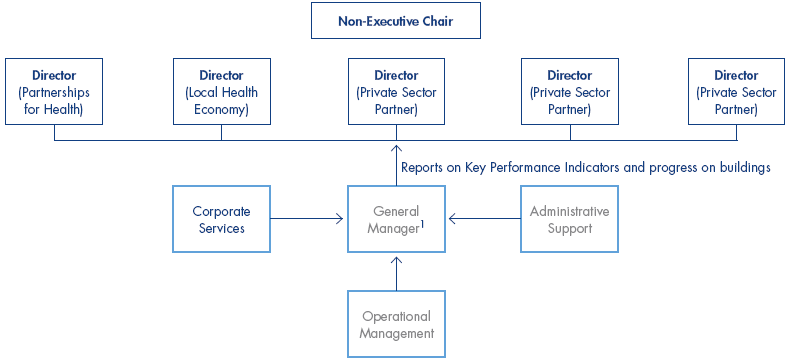
3.11 Two bodies with oversight functions, the LIFTCo board and the Strategic Partnering Board, have been established within local LIFT schemes. The roles of the boards are clearly defined by Partnerships for Health and there is a distinct separation of duties. The Strategic Partnering Board, comprising representatives from the local health economy, commission services and buildings to be delivered by the LIFTCo. The structure of the LIFTCo board comprises one non-executive chair and five directors; three of whom are from the private sector partner, one from the public sector and one from Partnerships for Health (Figure 12).
3.12 Partnerships for Health consider that the small and local nature of LIFT creates inherent difficulties for Board appointments. They believe that the benefit of securing the optimal candidate for a position outweighs the risk of conflicts of interest arising. As a consequence they did not issue explicit guidance about the likely background of candidates, but instead defined the attributes of individuals filling board positions on LIFTCo and on the Strategic Partnering Board. This has resulted in different local interpretations about who should be appointed public sector director of LIFTCo.
3.13 As a result, four of our six case study areas appointed Primary Care Trust Chief Executives or Finance Directors to act as public sector directors on LIFTCo. There is potential for a conflict of interest where these individuals have responsibilities to two organisations with different priorities - for example, if the LIFTCo was in financial difficulties, as a LIFTCo director a Primary Care Trust employee might have conflicting pressures between helping the LIFTCo and protecting the interests of the Primary Care Trust. Other LIFTCos did take steps to avoid these tensions - East London LIFT has appointed the chairman of a local hospital, to fill the role and in East Lancashire the public sector director will be rotated between Primary Care Trusts within the LIFT. To safeguard properly against tensions arising, however, there need to be clearer boundaries in place and Partnerships for Health could consider whether LIFT schemes would benefit from further guidance to help them manage those tensions that cannot be avoided. For example, the public sector director, in the role as a LIFTCo Board Member, has a fiduciary duty to act in the interests of the LIFTCo and not for the Primary Care Trust as a client or shareholder. These directors should, when in a difficult position in respect of their prime duty to the LIFTCo, refer matters back to the Primary Care Trust for a decision.
|
12 |
Structure of the LIFTCo |
|
LIFTCo Board (voting rights reflect equity stakes)
Source: National Audit Office |
|
|
NOTE 1 The LIFTCo General Manager/Chief Executive may be from a public or private sector background, they also serve as the link between the LIFTCo and the Strategic Partnering Board. |
|
3.14 Recruitment of non executives to chair the LIFTCo and Strategic Partnering Board has also presented difficulties for the local LIFT areas. Understandably most LIFT schemes only gave these appointments their full attention having reached the milestone of financial close and filling these posts has since been slow - as at January 2005 one of our case study areas is yet to appoint a LIFTCo Chair. Partnerships for Health consider that the independent chairs are central to the functioning of the boards and that nominees should be selected because they have the requisite skills to exert proper control and safeguard public sector interests. In practice, however, this has meant that independence of candidates can be overlooked. Of the appointments made to date in our case study areas we found two instances where the Chair of he Strategic Partnering Board was a local stakeholder in LIFT.
3.15 The accountability of the LIFTCo to the Strategic Partnering Board is well defined. It is unclear, however, to whom the Strategic Partnering Board is responsible beyond members being accountable to their individual organisations (e.g. Primary Care Trusts, Local Authorities). We have not been able to identify how or by whom the performance of the Strategic Partnering Board will be assessed and whether there are roles for Strategic Health Authorities or the Department in a general oversight framework. Additionally because the Strategic Partnering Board represents multiple clients, the LIFTCo's customer for each individual project is never defined. The important issue is that the Strategic Partnering Board makes it clear who the client is for the LIFTCo and monitors the relationship between the LIFTCo and the client. On an operational basis, where a project is driven by a single Primary Care Trust, it may be easier for the LIFTCo to deal directly with the Primary Care Trust as the customer. But, where a joined up delivery is required, the Strategic Partnering Board needs to act effectively as the customer of the LIFTCo.