Note 1 - The Issue Analysis/Dinner Party approach (IADP™)
2 The Issue Analysis /Dinner party approach (IADP™) is a methodological framework developed by the NAO as a means to deliver audit reports that are focused, logically rigorous and built on consensus. It helps structure an audit programme around which to base evidence collection and analysis (the aim of the issue analysis) and organise the resultant report in a clear and logical way (the aim of the Dinner Party™).
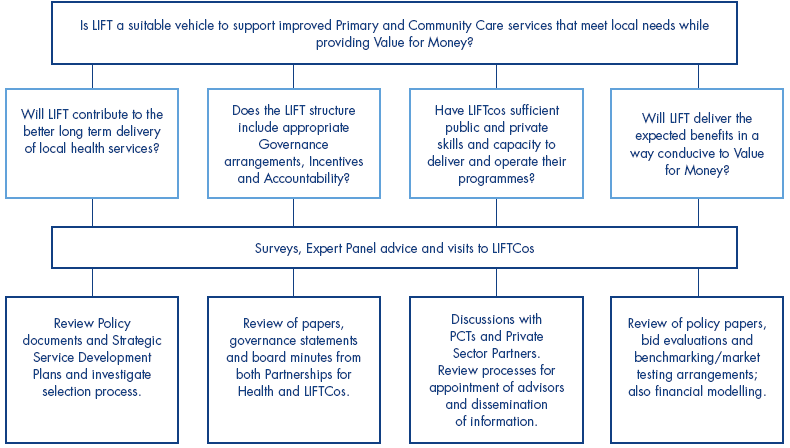
3 Issue analysis produces a series of yes/no questions terminating in audit tasks which indicate what hypothesis the auditor should seek to test and what method of data collection and/or analysis he or she should use. The high level questions that we based this audit around are in Figure 14. For each of the top level questions, we set a subsidiary group of questions, linked logically to the main question, in order to direct our detailed work and analysis.
4 The Dinner Party™ is based around what happens at a real dinner party, when you typically have only a short period of time to hold a fellow guest's attention. The Dinner Party™ meeting takes place after data collection
|
13 |
Methods used to undertake our examination |
|
|
|||
|
|
|
|
Study phase |
|
|
|
|
Method |
Issue identification |
Audit programme |
Evidence collection and analysis |
Report drafting |
||
|
Issue analysis (see note 1) |
|
|
|
|
||
|
Brainstorming |
|
|
|
|
||
|
Internet research |
|
|
|
|
||
|
Document review |
|
|
|
|
||
|
Stakeholder Interviews |
|
|
|
|
||
|
Surveys (see note 2) |
|
|
|
|
||
|
Statistical/financial analysis (see note 3) |
|
|
|
|
||
|
Consultation with expert panel (see note 4) |
|
|
|
|
||
|
Case study analysis (see note 5) |
|
|
|
|
||
|
Dinner Party™ |
|
|
|
|
||

and analysis is complete and the aim is to produce crisp, interesting report conclusions that can each be stated in 10-15 seconds, and to build up more levels of detail on that basis. In this case, the high level conclusions which resulted from the Dinner PartyTM process were:
|
14 |
The high level questions that we based this audit around |
|
|
|
■ The National LIFT Programme appears an attractive way of securing improvements in Primary and Community Care
■ The local LIFT models appear to be an effective mechanism clearly demonstrating Value for Money; however, local management frameworks could be strengthened.