Treatment of prisoners
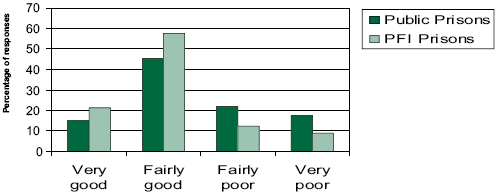
3. An important innovation by the private sector has been in promoting a more constructive staff/prisoner relationship. Staff in PFI prisons are encouraged to treat prisoners in a more positive manner, for example through the use of first names and mentoring schemes. When surveyed by the NAO, prisoners in PFI establishments felt that they were treated better and shown greater respect than prisoners in public prisons (Figure 2).2 The Prison Service and the contractors considered that PFI prisons had been able to develop such a culture because managers were opening a new prison with staff that could be trained to deal positively with prisoners.
Figure 2: Prisoners' response to the question "how would you rate the respect shown towards you by staff?"
Source: C&AG's Report
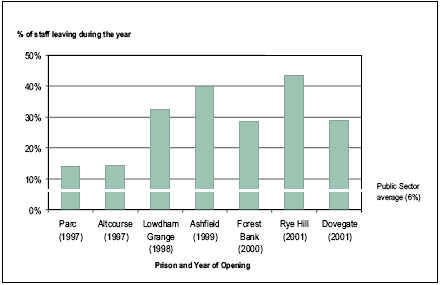
4. PFI prisons tended to have younger prison officers and more female officers than in public prisons.3 However, less experienced officers were at risk of being conditioned by prisoners to overlook security breaches. Most of the escapes from prisons in recent years had occurred in this way. There had been a high turnover of staff in most private prisons and in each case turnover was considerably higher than the average public sector figure of 6% (Figure 3). Turnover was particularly high in private prisons that had opened recently, possibly because many new recruits had no previous experience of prisons. The Prison Service was concerned that staff would not have long enough to learn how to manage prisoners. As prisons settled down over time, however, staff turnover had started to reduce, and the older private sector prisons now had a much lower staff turnover than the newer ones.4
Figure 3: Annual Staff Turnover (2001-02)
Source: C&AG's Report
5. In the public sector, where staff turnover was low, it was difficult to change entrenched attitudes. Staff had often entered the Prison Service many years before when there were different expectations about the treatment of prisoners, and the emphasis was on containment rather than rehabilitation. Getting the balance right in the way staff treated prisoners was crucial. Staff had to be able to work closely with prisoners whilst at the same time not being too trusting; otherwise there were security problems. The Prison Service was working to improve the way prisoners were dealt with in the public sector by recruiting more carefully and by training rather better.5
____________________________________________________________________________
2 C&AG's Report, paras 12, 2.18, Fig 13
4 Qq 12, 18-23, 27-28; C&AG's Report, para 2.20, Fig 16