5 Project Agreements
Diagram 8 below contains an overview of the PPP project at the national level. Each of the solid arrows and dotted boxes represent agreements to be discussed below. For projects that do not involve a separately incorporated project company, the contracting party for the project company should be replaced by the party that owns or has the right to operate the infrastructure asset.
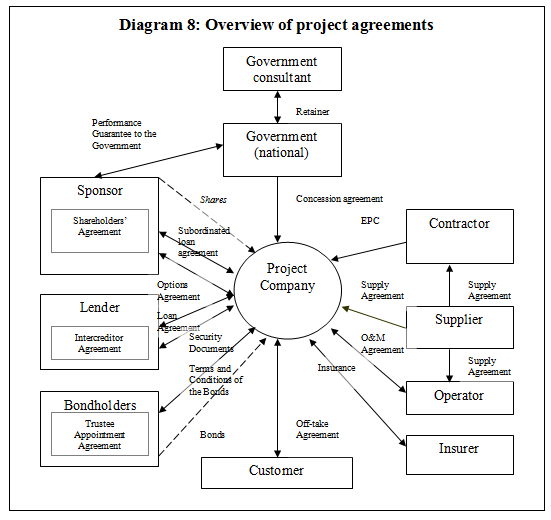
The agreements are grouped as follows:
• the agreements to retain the government consultants (under a section headed "Retainer");
• the concession agreements granting the right to operate the infrastructure (under a section headed "Concession");
• the agreements to provide equity finance to the project (under a section headed "Equity Finance");
• the agreements to provide debt finance to the project (under a section headed "Debt Finance");
• the agreements to provide quasi-equity finance to the project through issuing securities such as bonds (under a section headed "Quasi-equity Finance");
• the agreements to design, construct, operate and maintain the infrastructure (under a section headed "Design, Construct, Operate and Maintain"); and
• the agreements with customers of the infrastructure services (under a section headed "Off-take agreements").
Each of these categories is discussed in a separate section under this chapter. For each of the group of agreements, a subsection headed "The Government's Concerns" describes the important issues for the government in relation to those group of agreements. The purpose of setting out the government's concerns separately is to ensure that the main objectives, concerns and issues of the government for a PPP project are not lost in the detail and complexity of the transaction. Each of the project agreements is then separately described and discussed, with an outline of the "Key Issues" under a separate subheading. The "key issues" are the issues that are important in the agreements, and are therefore often heavily negotiated and discussed. The rationale of having an outline of the issues is that the reader could turn their minds to these issues in preparing or instructing a lawyer to prepare an agreement, or in commenting on the agreements provided by the counterparty.
The PPP project agreements can be lengthy and complex, but keeping in mind the important issues from the point of view of the government hopefully ensures that the reader is not lost in the detail of the agreements.
Although each project agreement will be discussed separately, it is important to consider all the project agreements as a whole because each agreement is interdependent of the other. The contract documents should be consistent and complementary. This is important in the structure as well as the detail of the agreement. For example, unless there are compelling reasons otherwise, "boilerplate" clauses such as force majeure, governing law, jurisdiction and notices clauses should be identical, and all provisions in relation to termination, dispute resolution and events of default should be consistent.