7.1 INTRODUCTION
7.1.1 Authorities should consider carefully, at an early stage in their procurement planning, the range of services which need to be provided through the Contract. Services provided by the Contractor are referred to in the Contract as "Services". Services retained by the Authority and performed by itself or its own sub-contractors are referred to as "Authority Services". Soft services (such as cleaning, catering, security) together with the ongoing replacement of furniture and loose equipment, should be retained by the Authority and excluded from the Contract, except in exceptional circumstances (such as in the prisons sector) where these services are integral to the delivery of the project and better value for money can be demonstrated by transferring them.
7.1.2 There is a second class of minor maintenance services however which Authorities have a discretion to retain or transfer; this decision should be made during the procurement planning stage. These services, when retained by the Authority, are known as Minor Maintenance Obligations (but when transferred to the Contractor become part of the Contractor Services). These include internal redecoration of walls and ceilings, replacement and repair to replaceable floor coverings, and other minor maintenance activities such as low level inspections / minor repairs. Responsibility for these must be clearly specified by the Authority in the Contract.
7.1.3 To add further flexibility, there is a third class of services, known as "Elective Services", which should be individually priced by the bidder and which the Authority may choose to retain or transfer (at the pre-agreed price) over the life of the Contract. These services may be transferred at a pre-agreed price without having to rerun the Base Case. An example of what the overall matrix of services could look like is set out over the page.
7.1.4 As stated above, the presumption is that soft services will not be included as part of the range of services to be provided by the Contractor under the Contract. Accordingly, the Authority will normally appoint its own soft services provider, or deal with this service in-house. The Authority's service provider will become an Authority Service Provider and an Authority Related Party under the Contract. Where it appoints such an Authority Service Provider, the Authority will need to take responsibility for the performance of such service provider as against the Contractor. Authorities will also need to give particular attention to any interface issues which might arise. Guidance on interface issues is set out below at Sections 7.10 - 7.14. All decisions on what services to include in the Contract (and, indeed as to whether the PF2 model is the right model for the Project) should be determined on value for money grounds (see Chapter 7 (Delivering value for money) of HM Treasury's PF2 policy document entitled "A New Approach To Public Private Partnerships."
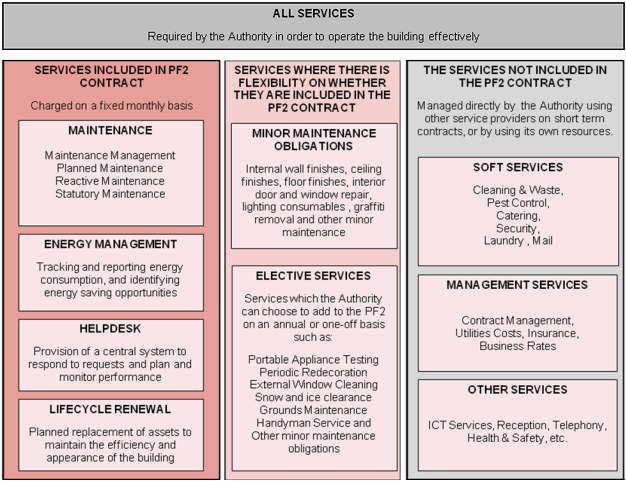
7.1.5 Minor Maintenance
As there is no standard industry definition of minor maintenance the Output Services Specification will need to specify those matters which are classed as minor maintenance. These are services which the Authority may wish the Contractor to perform or alternatively to retain itself as Authority Maintenance Obligations. The Authority may need training for some of these by the Contractor.1
The Authority has a free hand to choose whether or not to provide maintenance for internal floor finishes, wall finishes and ceiling finishes itself, but responsibility for other minor maintenance should only be taken by an Authority (and included within Authority Maintenance Obligations) where:
• the Authority has existing resources capable of carrying out the maintenance (such as caretakers, janitors or handymen) - although the use of additional resources / contractors by the Authority should not be specifically excluded;
• TUPE transfer of the relevant operational staff to the Contractor will not occur; and
• soft services are being retained by the Authority (as will normally be the case).
Authority Maintenance Obligations should specifically exclude:
• work requiring specific qualifications or trade skills (such as electrical or gas engineers);
• work on systems integral to the building systems - such as electrical systems, CCTV, fire alarms, BMS, gas, Air conditioning, etc; other than specific low skill testing or inspection;
• work involving the external fabric of the building (other than graffiti removal) - such as window replacement, door replacement, refinishing render or brickwork; and
• any work involving the structure of the building.
Schedule 3 (Services Output Specification) includes a non exhaustive list of items that could be included within Authority Maintenance Obligations and the scope and limitations that might apply, depending upon the resources and skills of Authority staff and the specifics of building design.
7.1.6 Elective Services
In order to provide the Authority with greater flexibility to choose, annually, to procure certain services through the Contractor, or alternatively to retain them itself, a range of Elective Services will be proposed and agreed prior to Financial Close. These will be services which can reasonably be provided within the normal skill set of the Contractor and which could provide value for money and convenience to the Authority if they are added to the scope of Services; however the Authority would retain the right to withdraw them or procure them from other providers if it preferred. These services would be pre-priced on a fixed basis so as not to require a rerun of the Base Case if taken out of the Services obligation. They would be treated as a small service change under the Change Protocol (see Section 11.3.3 (Change Protocols)).
For such Elective Services:
• the Contractor will be expected to provide a fixed price within their submission, taking account of their design and their own capacity to deliver them, or subcontract them to a sub-contractor;
• the price should be subject to annual indexation, and periodic value for money testing;
• the list of Elective Services can include:
o relevant Authority Maintenance Obligations (enabling the Authority to elect to pass these services back to the Contractor for the additional fixed price identified) and
o relevant Contractor Services (enabling the Authority to elect to bring back those services from the Contractor for the cost reduction specified);
• the Contractor must take the risk that the services can actually be delivered at the (indexed) price whenever the Authority elects to instruct; and
• the price stated for the Elective Services should allow for all costs, ensuring that a rerun of the Base Case is not triggered.
An indicative Elective Services catalogue is included in Schedule 3 (Services Output Specification).
7.1.7 The Services to be provided by the Contractor should be specified in detail in response to the Services Output Specification to be prepared by the Authority. Whilst principally relating to Hard FM and lifecycle maintenance, these Services may include incidental IT services which are ancillary to the Services or the Facility. A standard template Services Output Specification, which must be used (with sector-specific adjustments if necessary) is included in Schedule 3 (Services Output Specification).
7.1.8 In the minority of cases where the Contractor does take responsibility for soft services (i.e. where there is full service provision) the market testing provisions set out in Schedule 2 should be adopted.
The following is suitable drafting for the provision of Authority Services:
7.1.8 Authority Services
(a) The Authority shall itself perform, or procure that the relevant Authority Related Party shall perform, the Authority Services in accordance with the requirements of Legislation [and the Interface Protocol].2
(b) Where the Contractor becomes aware of any breach by the Authority of Clause (a) above, the Contractor shall as soon as practicable thereafter notify the Authority of the breach and, so far as it is aware of the same, the nature of the circumstances that have caused the breach.
The Contractor shall ensure that, when providing "as-built drawings" in respect of the Facility, it shall at the same time provide such additional instructions and guidance in relation to the safe operation and maintenance of the Facility, and any other relevant property, as would commonly be provided by a building contractor (acting in accordance with Good Industry Practice) to a provider of services the same as or similar to the Authority Services to enable that person to operate the Facility safely and without causing damage.
Definitions
"Authority Maintenance Obligations"
means those Minor Maintenance Obligations which the Authority has decided to carry out itself, or procure their provision by an Authority Service Provider, as permitted by the Contract
mean
(a) the services described as soft services in Part 2 and listed as soft services in Part 4 of Schedule 3 (Services Output Specification);
(b) the Authority Maintenance Obligations; and
(c) the Elective Services (except to the extent that the Authority has at any time elected that the Contractor shall carry out such services as permitted by the Contract);
means an Authority Related Party appointed by the Authority from time to time to undertake all or any part of the Authority Services;
"Authority Services Training Plan3"
means the plan relating to the training of staff responsible for delivering the Authority Services as agreed between the Authority and the Contractor;
means those services described as such in [Part 2 and listed as such in Part 4 of Schedule 3] (Services Output Specification) any of which, under the terms of the Contract, the Authority may elect from time to time, either (a) that the Contractor performs as part of the Services or (b) that the Authority retains as part of the Authority Maintenance Obligations;
means the protocol as agreed between the Authority, the Authority Service Provider (s) and the Contractor and/or a Contractor Related Party from time to time regarding co-operation, liaison and access between the Authority Service Provider(s) and the Contractor and/or Contractor Related Parties;
"Minor Maintenance Obligations"
means those services listed as such in Part 2 (Minor Maintenance Obligations) of Schedule 3 (Services Output Specification);
"Services"
means the services required to satisfy the Services Output Specification including, without limitation, any (a) Elective Services which the Contractor is required to provide from time to time under the Contract and (b) any Minor Maintenance Obligation which the Authority has not retained as an Authority Maintenance Obligation;
means the commencement of the Service;
means the date4 on which Service Commencement occurs in accordance with Section 7 (Services and Service Commencement);
"Services Output Specification"
means the Services output specification of the Authority contained in Schedule 3 (Services Output Specification);
_____________________________________________________________________________________________________
1 If the Authority enters into a separate contract in relation to maintenance, it should note that the Housing Grants Construction and Regeneration Act 2006, as amended, may apply to that contract.
2 Only include if the Interface Protocol is legally binding (see Clause 7.11 (Authority and Contractor Services Undertaking and Duty to Cooperate).
3 To be provided by the Contractor and to set out training needed for the Authority Services Provider(s) as regards to Authority Services provision. For example, training to understand the security, alarm, utilities, the Authority and the building management systems.
4 This assumes a single Service Commencement Date. To the extent a project has more than one Service Commencement Date (see Section 7.8 (Handover, Commissioning, Mobilisation, Acceptance and Service Commencement)), this will need amendment to recognise that partial provision of the Service may commence prior to the main Service Commencement Date. See Section 7 (Services and Service Commencement).