Lists
22. Perhaps the key indicator that you are managing the preferred bidder process well is the proliferation of lists that should emerge at this stage. Everything that is outstanding needs to be written down and worked through methodically. As already stated, the IPT should be clear on the basis of appointment of the preferred bidder - part of which includes the provision of a list of its outstanding issues. The preferred bidder should be asked to accept that list or add to it in its response to the appointment letter. As issues are discussed the initial list will expand and when lenders become heavily involved may expand significantly. This is normal. The key is having a strategy for dealing with the issues on the list.
23. Issues can be allocated generically according to subject matter. They may be technical, financial, commercial/legal or partnering issues. They will more than likely overlap and those tasked with taking forward their resolution need to be mindful that resolving a given issue in a "silo" is not likely to have achieved resolution at all. The graphic below represents the key interfaces that will be of concern to the IPT and the other main players - an issue can only be deemed fully resolved if the individuals at the centre of these overlapping circles (on all sides) have reached agreement. Paragraph 53, for example, looks at the pivotal importance of the financial model and key assumptions in negotiations - it is clear from the graphic below that work done on the model needs to be understood in the context of the commercial and technical spheres of the project.
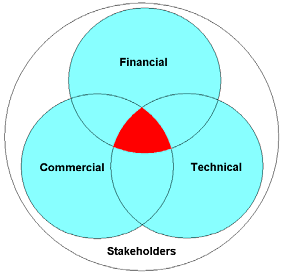
24. Issues should be ranked in order of importance to the IPT and in order of importance to the preferred bidder and (if possible) in order of importance to lenders. Clearly, it is difficult for the IPT to guess with absolute accuracy the relative importance of issues to the other parties - but with good external advice and the application of some common-sense it should be able to have a reasonable stab at this. The key thing is to put yourself in the shoes of the other parties and imagine what their constraints and commercial drivers are likely to be - they will certainly have analysed the Authority's position on this basis and will, for example, use any "drop dead date" which has been disclosed as a lever in negotiations (see paragraph 41 below for a discussion about deadlines). Of course, if earlier guidance is heeded then the scope for discussion on key commercial issues will have been limited through the scoping activity.
25. Once you have an idea of the terrain that you have to cross with your preferred bidder you can think about how you tackle those issues. It may that there are, for example, technical, financial or commercial aspects which can be hived-out into separate work streams - for example, you may have a sub-group work on the service management regime. If you do structure the negotiation through work-streams it is imperative that those at the centre are kept up to date with issues as and when they are "resolved" and can factor resolution on discrete areas into wider discussions which are ongoing (see paragraph 23).
26. On many projects the IPT (and the preferred bidder) have taken the view that they need to comprehensively visit all outstanding issues on the list at least once before they are in a position to have a definitive negotiation. This makes some sense since it allows each party to have its say on issues serially and then step back and look at the overall "shape" of the deal. It is also a good use of time in that the lenders' technical advisers can make their first pass of the technical solution and requirement and begin firming up on the degree to which these documents conform with the "in principle" position adopted by lenders during the competitive stage. You may not reach resolution on all (or even most) issues during this "first pass" but - if managed properly and comprehensively - it should facilitate a better final negotiation stage and is good a platform on which to add the detailed concerns of lenders once they have had a chance to review the documentation. Clearly the view an IPT takes on an such approach will be coloured by the number and complexity of issues which it faces - it is therefore critical that a concerted effort is made as soon as possible (ideally flowing from the evaluation of the bidder during competition) to identify all outstanding issues and list them in detail.
27. Lists are also an IPT's audit trail. There should be regular meetings convened to work through outstanding actions and push forward progress - but such meetings should clearly not be so frequent as to hamper actual negotiations of substance. The preferred bidder stage will generate its own momentum and nearing commercial close the IPT will probably find itself locked into a heavy meeting schedule. At that stage it is critical that the list of outstanding issues is updated and you must make time in the day to de-brief the team and update the list so as to inform the agenda of subsequent meetings. We have set out at Appendix 2 a pro-forma list which can be adapted and used by IPTs. The list should be viewed as a living document which is updated regularly by the IPT and its advisers (and to aid clarity each of these should use a different colour or font in so doing). The IPT should clearly not share all of the content of its list as it develops with the preferred bidder. Columns 1-3 (serial, reference and title) are all that can actually be shared since the rest of the document will be a reflection of the combined thoughts of the IPT and its advisers and form the negotiation brief.