The extent to which savings have been sought
3.1 The savings reported by departments to the Treasury (both signed and pipeline savings9) derive from just 118 of the 684 operational contracts. The remaining 566 operational contracts have a total remaining unitary charge of £151 billion. The extent to which departments have engaged with HM Treasury to date varies significantly.
3.2 Figure 5 shows the remaining unitary charge by department (according to Treasury data), the number of contracts that each department has (or which it sponsors), and the total signed savings each department has reported to the Treasury as at June 2013.
______________________________________________________________________________
Figure 5
Departments' remaining unitary charge, number of contracts and reported signed savings
| Department | Total remaining unitary charge (£ million) | Total | Reported |
| Department of Health | 69,397 | 209 | 61 |
| Ministry of Defence | 37,498 | 44 | 252 |
| Department for Transport | 27,715 | 62 | 478 |
| Department for Education | 24,023 | 167 | 2 |
| Department for Environment, Food & Rural Affairs | 17,901 | 27 | 39 |
| Ministry of Justice (note 1) | 6,694 | 27 | 88 |
| Department for Communities & Local Government | 5,720 | 63 | 0 |
| Department for Work & Pensions | 3,606 | 3 | 49 |
| Home Office | 3,604 | 23 | 95 |
| Other local projects (note 2) | 2,384 | 2 | 0 |
| HM Revenue & Customs | 2,383 | 6 | 22 |
| Department for Business, Innovation & Skills (note 3) | 1,672 | 18 | 0 |
| Department for Culture, Media & Sport (note 1) | 1,625 | 26 | 0 |
| Foreign & Commonwealth Office | 1,451 | 2 | 317 |
| HM Treasury | 751 | 1 | 144 |
| Department of Energy & Climate Change | 93 | 2 | 3 |
| Cabinet Office (note 4) | 48 | 2 | 53 |
| TOTAL | 206,565 | 684 | 1,603 |
NOTES
1. This is the position as reported at June 2013, the Department for Culture, Media & Sport and the Ministry of Justice are in discussion with the Treasury over the number of schemes and allocation of sponsorship.
2. Two local regeneration projects do not have a departmental sponsor.
2. The Department for Business, Innovation & Skills has only two projects in the public sector. A further 16 projects which amount to 99 per cent of the remaining unitary charge are managed by Higher and Further Education institutions which are classified as private sector by the Office for National Statistics.
4. The Cabinet Office saving comes from cancelling a PFI contract. The value of the saving is more than the value of the contracts because, alongside the unitary charge, some ancillary costs have also been saved.
5. Figures based on HM Treasury data at June 2013, and do not reflect subsequent changes.
Source: HM Treasury data at June 2013.
______________________________________________________________________________
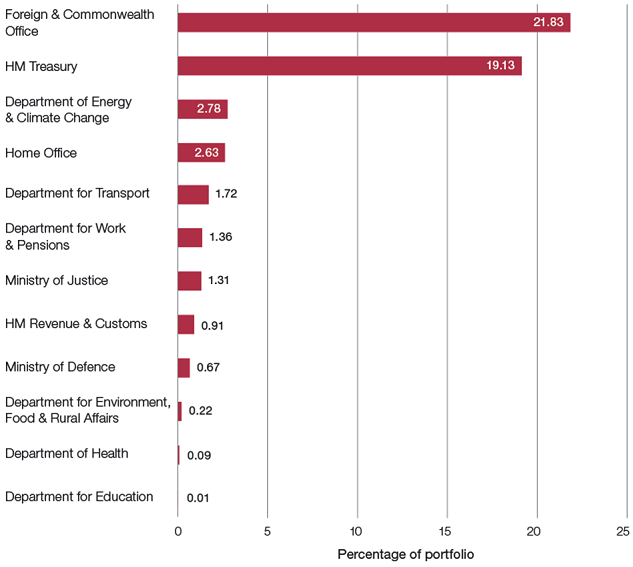
3.3 The volume of contracts and the value of the total remaining unitary charge significantly varies by department. The Cabinet Office, the Treasury and the Foreign & Commonwealth Office have all reported savings in excess of 20 per cent of the total remaining value of their operational PFI contracts. The savings reported by the Foreign & Commonwealth Office and the Treasury relate to more intensive use of accommodation use.
3.4 Figure 6 shows, by department, the value of signed savings reported to the Treasury as a percentage of the value of the total remaining unitary charge for that department's operational PFI projects. Thirteen departments out of 16 have reported savings of less than 3 per cent of the value of their total remaining PFI unitary charge. Three departments (the Department for Business, Innovation & Skills, the Department for Culture Media & Sport and the Department for Communities & Local Government) have not yet reported any signed savings to the Treasury under the current savings initiative. As noted in paragraph 2.7, the Department for Communities and Local Government has reported other savings that fall outside of the scope of this review.
______________________________________________________________________________
Figure 6
Departments' reported signed savings as a percentage of their total remaining unitary charge
NOTES
1. This table only shows the £1.6 billion of signed savings that fall within this savings initiative.
2. The Cabinet Office is excluded from the above analysis as its saving is 112 per cent due to the cancellation of a PFI contract which has saved ancillary costs alongside the unitary charge.
3. The Department for Business, Innovation & Skills, the Department for Culture, Media & Sport and the Department for Communities & Local Government have reported no signed savings under this savings initiative.
4. The Department for International Development is not included as it has no PFI projects.
Source: National Audit Office analysis of HM Treasury data
______________________________________________________________________________
3.5 Some contracts may have been evaluated and set aside as having too little potential. However, we are concerned that some contracts may not have been evaluated at all. This concern is based on the similarities we observe between contracts where savings have been reported and others where no savings have been reported. We conclude there is likely to be further scope for savings to be identified by authorities that have so far not reported any savings.
3.6 This lack of savings on so many projects is surprising given the fact that authorities can keep the savings they identify. The reasons for a low level of reported savings from some authorities may include:
• A lack of the necessary skills and expertise. The largest savings reported so far come from authorities with the skills to identify and negotiate savings, and the capacity to take some tasks back inhouse where it is cheaper to do so.
• A lack of resources to actively manage contracts. Authorities that have reported savings planned their changes to the contracts well in advance of key contract dates. One authority made good use of break clauses which, after planning and careful option appraisal, led to substantial cost savings. Devoting sufficient resources to contract management puts an authority in a much better position to identify savings.
It is also the case that some authorities may have agreed savings at a local level but not reported those savings to the Treasury.
_____________________________________________________________________________________
9 Signed savings derive from 65 PFI contracts. Pipeline savings derive from 53 PFI contracts.