5. Procurement Options
|
| • Public provision or contract out? • Are there 'specific' assets? • Conventional procurement or PPP? • Allow scope for innovation |
Having identified the characteristics of the service need, the next question is how it should be procured.
The decision tree in figure 2 places the question of whether a PPP is appropriate into a wider procurement decision framework:
Figure 2: Procurement Decision Framework
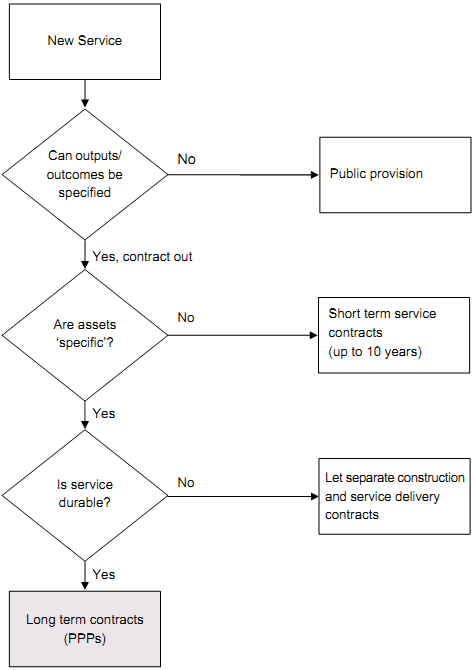
As a general rule, if the service can be well-specified, then a market-based contractual relationship is preferable over a "master-servant" type of relationship. This is because the clear performance specification that is the basis of a contract can be linked to financial incentives which deliver stronger performance, resulting in greater cost efficiency and a better quality product. 'Master-servant' relationships are preferable where the service provider is expected to 'guess' what the client wants, ie, where the quantity or nature of the service is difficult to specify in advance.
If a service can be well-specified, then the next step is to consider whether the service can be purchased from owners of existing assets or whether the market needs to make a specific-purpose investment (also referred to as 'specific assets'). Specific-purpose investments are those which can only be used for a particular client. For example, if someone builds a corrections facility for the government, if the contract is terminated then the contractor cannot use the facility for other clients. A corrections facility is therefore a specific-purpose investment.6
Where there are no large specific-purpose investments, it is preferable for the government agency to buy the service from the market without the government making a capital investment. For example, office accommodation in a big city is typically best rented.
If the required investments have a significant specific-purpose component, then there are two choices:
• The government lets a contract for the construction of the facility and lets a separate contract for operating the facility. This is known as 'conventional procurement'. In this situation the government owns the facility and the operating or service contract can be re-tendered periodically (eg, every 5 years).
• The government lets a long term contract for both construction and service delivery. This is known as a concession agreement, a form of public private partnership (PPP). The service can be either a full service or it can be just the maintenance of a facility, or something in between. For example, if the facility is a school, then the contractor could be responsible for maintenance and the provision of computing services, with a separate government agency being responsible for providing teachers and the educational service.
However, innovation and whole-of-life cost minimisation are more likely achieved if the PPP is a full-service contract. In addition, full service contracts are less likely to leave substantial interface risks with the public sector.
The choice between conventional procurement and a PPP largely depends on whether the service is durable, ie, how likely it is that the service requirement will change over time in unpredictable ways, requiring costly contract variations. This choice is discussed in some detail in the next section.
_________________________________________________________________________________
6 In the United States, state governments are typically not concerned about sending inmates into corrections facilities out-of-state, so a corrections facility owner who loses a state contract is able to sell custodial services to other state governments. Those facilities are therefore not specific assets in the sense used here.