The context and key points of the 2011 National Infrastructure Plan
| The context and key points of the 2011 National Infrastructure Plan |
| Infrastructure refers to the fixed, long-lived structures that facilitate the production of goods and services and underpin many aspects of quality of life. Infrastructure is made up of physical networks, principally transport, water, energy, communications and social assets. |
| Infrastructure context |
| » Infrastructure forms the backbone of all New Zealand communities, and every New Zealander needs a greater level of confidence about infrastructure provision, costs and service levels. » Infrastructure is an important component of the Government's strategy for achieving economic growth - it provides the supporting networks demanded by a growing economy and it catalyses growth by creating new economic opportunities. » Local government is a significant owner of transport, water and social infrastructure. The private sector plays a critical role as investors in economic infrastructure and providing skills and expertise in planning and design, construction and asset management. » High-quality infrastructure attracts industry and business to New Zealand. A major focus of the Plan is on providing businesses with greater certainty and confidence about current and future infrastructure provision. » Infrastructure assets are typically long-life, costly and can take many years to plan, commission, build and bring into service. Projecting the future demand for infrastructure is critical to ensuring that the right level of investment is made in the right infrastructure at the right time. » Historically, investment in New Zealand's infrastructure has been lumpy with significant periods of under-investment. » In the latest World Economic Forum Global Competitiveness Report (2013/14), New Zealand ranked 27th out of 148 countries for the quality of our infrastructure, an improvement over 2012/13 where we rated 30th. However, further improvement is required as the 2013/14 report still rates "Inadequate supply of infrastructure" as the most problematic factor for doing business. |
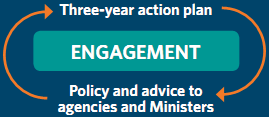
| The NIU works with other government and private sector agencies to deliver the outcomes of the Plan, with the overall implementation approach a mixture of engagement and dialogue, developing partnerships, projects, research and reporting. |
|
|
| The Plan is a strategic, future-focused document that places infrastructure in the context of economic and population growth. It seeks to provide common direction for how we plan, fund, build and use all economic and social infrastructure. It covers the transport, telecommunications, energy, water and social infrastructure sectors. |
| VISION | By 2030 New Zealand's infrastructure is resilient and coordinated and contributes to economic growth and increased quality of life. | ||
|
| There are two outcomes the Government is looking to deliver through the Infrastructure Plan: | ||
| OUTCOMES | Better use of existing infrastructure ... Getting more from the current stock of infrastructure is about looking at how assets are used, identifying opportunities for improved management, finding better ways of managing demand and ensuring users' expectations are understood. |
| Better allocation of new investment New Zealand needs to be smarter about investing in new infrastructure. The Government will prioritise investment where there are adequate returns and these are underpinned by robust analysis through a well understood and transparent process. |
|
|
|
|
|
| Key challenges identified in the Plan |
| Guiding principles from the Plan | |
| 1 | Infrastructure investment is well analysed at the project level but there is insufficient consideration of how assets function as a network or address potential changes in demand. |
| Investment Analysis Investment is well analysed and takes sufficient account of potential changes in demand. |
| 2 | New Zealand's infrastructure is vulnerable to outages, including through natural hazards, and we have insufficient knowledge of network resilience at a national level. |
| Resilience National infrastructure networks are able to deal with significant disruption and changing circumstances. |
| 3 | The volatile nature of infrastructure funding creates a lack of certainty and continuity for infrastructure providers. There is insufficient use of the tools available to generate revenue and manage demand. |
| Funding Mechanisms Maintain a consistent and long term commitment to infra-structure funding and utilise a broad range of funding tools. |
| 4 | The performance of infrastructure assets is not transparent. It is not always clear who is accountable for decisions. |
| Accountability and Performance It is clear who is making decisions, and on what basis, and what outcomes are being sought. |
| 5 | The regulatory environment does not support long term infrastructure development and contributes to unnecessary costs and uncertainty. |
| Regulation Regulation enables investment in infrastructure that is consistent with other principles, and reduces lead times and uncertainty. |
| 6 | Poor coordination between different infrastructure providers leads to suboptimal outcomes. Decisions over land use and infrastructure investment could be better integrated. |
| Coordination Infrastructure decisions are well coordinated across different providers and are integrated with decisions about land use. |
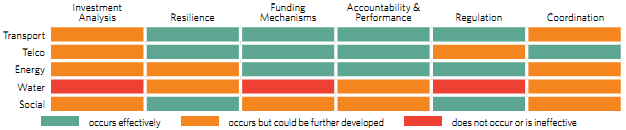
Traffic lights assessments of each sector as they appeared in the 2011 Plan
The Plan journey
| 2009 | National Infrastructure Unit and National Infrastructure Advisory Board established. |
| 2010 | First National Infrastructure Plan released, providing the context and a snapshot of what infrastructure we have, settings, roles and responsibilities, immediate infrastructure priorities and a sound set of principles to consider for future investment. |
| 2011 | Second National Infrastructure Plan released, setting out a strategic vision and direction, the two key outcomes and the guiding principles that inform our advice and thinking. This Plan also included a multi-year work programme that we are part way through delivering. |
| 2012- 13 | Delivery of the multi-year work programme based on a 'Pressure-State-Response' model. The first phase of the work programme has been focussed on building the evidence base around the 'Pressure' and the 'State' questions. Plan workstreams that contribute to building this evidence base are the Performance indicators (State); Trends and scenario modelling (Pressure); Resilience (Pressure and State); Demand management (Response), and the delivery of the first ten-year Capital Intentions Plan (Response). These workstreams will come together early in 2014 in the first collated evidence base and the initial story it depicts. |
| 2014 | Using the collated evidence base and initial story as a base for more in-depth discussions to both refine the story and develop an agreed and prioritised 'Response' (action plan). Focussing on the 'Response', 2014 will also complete the multi-year work programme including the Alternative funding workstream. |
| 2015 | This stage of the Plan journey will culminate in capturing the refined story and prioritised response into a New Zealand National Infrastructure Plan. |