Transport
| The year Economically, the transport network plays a critical role in shifting goods to our export ports, delivering goods from suppliers and delivering workers to businesses. Recognising this, the Government has continued to invest heavily in the transport sector. At $12.28bn, the 2012-15 National Land Transport Programme is the largest ever. Achieving value for money is also a key focus. One of the most far-reaching initiatives has been the report of the Road Maintenance Taskforce published in October 2012. Three of the four areas for improvement the taskforce identified were: • Improved procurement practices • Improved prioritisation and optimisation through level of service differentiation • Consistent introduction of enhanced asset management practices. The road controlling authorities of New Zealand have combined to form the Road Efficiency Group, to implement the findings from the Road Maintenance Task Force. The group is working on: a one network classification - building off the state highway classification system and best practice from local government; investigating collaborative procurement opportunities; and sharing asset management experiences to develop 'best in practice' procedures. Implementation of the report has driven a number of changed and innovative practices across the country. One example we have previously profiled in our Infrastructure Update is the Southland District Council and their use of an Economic Network Plan - analysis of the roading network based on land use. Together, these new practices and analyses are extending the debate around the appropriate responses to future demand, and connecting into the levels of service the infrastructure needs to provide. This leads to greater accountability and performance, and more robust investment analysis. These changes are driven by new and different information. The Freight Information Gathering System (FIGS) is progressively providing a system-wide quarterly report on freight movements into, out of and around New Zealand. In the past year, the FIGS project has expanded to include information on freight movements from all ten container ports, rail movements, and New Zealand import-export data. Bringing together data from both the private and public sectors, the information provided by FIGS will allow infrastructure and planning decisions by companies, central and local government to be based on robust, reliable and consistent data. Coordination has been a key theme of the Plan and the FIGS project demonstrates the potential gains. Similar results are also expected from the three regional freight projects underway covering the upper North Island, central North Island and South Island. Engaging the private sector, local government and central government, the freight work is already showing dividends in better understanding the future demands on the transport network and delivering a coordinated response that cuts across traditional regional boundaries. The past year has seen continued streamlining of the regulatory process. This builds on the new board of inquiry process that was used for Waterview, Transmission Gully and the Kapiti Expressway. |
| Overview The significant investment programme in transport continues, along with increasing coordination and a developing evidence base to underpin discussions. Balancing supply side interventions with work to optimise the existing network, and ensuring the sustainability of the funding system, are key to meeting future challenges. |
| Highlights from the past year | Opportunities/challenges |
| » Ongoing investment and progression of significant transport projects, including the Roads of National Significance, the 10-year KiwiRail Turnaround plan and urban commuter networks. » Transmission Gully PPP preferred bidders selected. » Upper North Island Freight Story completed. » The Land Transport Management Act was amended to simplify the planning and funding framework for land transport. » The implementation of the Road Maintenance Taskforce recommendations has commenced. » Progress on investigating the viability of a ferry terminal at Clifford Bay. » The Government has issued its response to the Productivity Commission's report on freight and begun implementing recommendations - including expanding the Freight Information Gathering System (FIGS). » New funding frameworks were introduced for Maritime NZ and the Civil Aviation Authority to ensure that users meet the full costs of the services they receive. » The Commerce Commission reviews of information disclosures on airport pricing were completed for Wellington and Auckland International Airports. | » Increasing understanding of the role that transport plays in achieving the BGA growth targets, especially increasing exports from 30 to 40 percent of GDP. » Regional transport plans need to take account of intermodal connections, plans or opportunities for changes in use of sea and air ports and the transport implications of proposed changes in land use. » Working through the tension about local roads funding. Constrained funding drives the need to better understand levels of service and alternative ways of gaining efficiencies through collaboration. » Balance the provision of new or improved transport links with optimising the use of the existing network, especially urban commuter and strategic freight routes. » Ensuring that we getting the best value from the investments made in transport. This includes, for example, managing variations in revenue to meet expenditure commitments, developing a better understanding of future transport demand and ensuring that the costs of construction against long-term expenditure pressures including future demand and ensuring the costs of procurement are contained. » Developing a common understanding of resilience across the transport sector. |
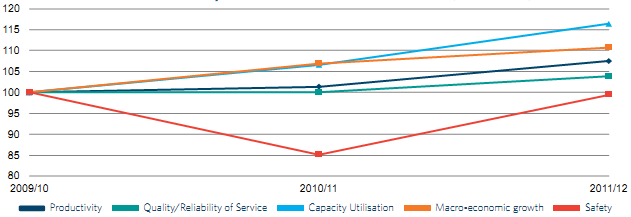
| A selection of rail performance indicators (2009/10 -2011/12) |
|
|
| Source: KiwiRail Annual Reports, Statistics New Zealand |