Telecommunications
The year Fast and reliable telecommunications enable customers to connect with businesses, and connect New Zealand to the world. Beyond a productivity enabler, telecommunications and fast broadband are already shaping how social infrastructure is delivering education, health and justice services. To deliver this potential, a major focus for the year has been the Ultra-Fast Broadband (UFB) and the Rural Broadband Initiative (RBI). Network deployment of this scale requires a number of implementation issues such as land access arrangements to be worked through. These issues are likely to continue to arise. Regulation has been a second major focus with the commencement of two reviews: • Telecommunications Service Obligations (TSO) Review -"the primary objective of the TSO Review is to determine whether there remains a need for TSO protections to ensure the availability and affordability of basic telecommunications services to groups of end-users to whom those services may not otherwise be supplied on a commercial basis or at an affordable price. • Telecommunications Act Review - The first phase of the review is focussing on the relationship between pricing for the legacy copper network services and pricing for the new fibre network during the transition period until 2020. As part of the first phase of the review, the Government is seeking initial feedback on issues to be considered in the remaining parts of the review. A third major area of work over the past year has been the restacking of the 700MHz spectrum in preparation for the auction starting in October 2013. This spectrum is likely to be used in the building of fourth generation (4G) mobile networks, which can provide substantial economic benefit to New Zealanders. Resilience has featured in a number of discussions over the year, highlighting the dependency of many critical infrastructure systems on the ability to communicate remotely and send/receive data. It has also arisen in relation to the diversity of New Zealand's international connections via our submarine telecommunications cables. Announcement of a second cable to Australia (Tasman Global Access) and the ongoing investigation by Hawaiki of a further cable with a landing in Northland, have the potential to greatly expand the existing physical route diversity and overall resilience of the international cable system. Internationally, there is growing interest and attention on telecommunications interception capability and security. A new Bill has been introduced to Parliament to replace the Telecommunications (Interception Capability) Act 2004. The Bill updates interception capability obligations on the telecommunications industry, and introduces a formal framework for network security (from a national security perspective). |
Overview The 700MHz spectrum has been prepared for auction and discussion documents for the two telecommunications reviews have been released. Continuing to ensure that the UFB and RBI network deployment programmes are on track remains a focus. |
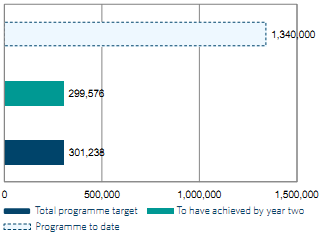
Highlights from the past year » Infrastructure deployed through the UFB and RBI programmes becoming operational in many areas for the delivery of services to end users. » As at 30 June 2013, 26 towns and cities had UFB available with 70% of public schools having fibre, and 33 remote schools connected. Uptake is gathering momentum with a 95% increase in UFB connections in the quarter ended 30 June 2013 over the previous quarter. » Preparation for the 700MHz auction and announcement of a rural implementation requirement which, when combined with existing urban implementation plans, mean that 90% of the population will have access to 4G wireless broadband services within 5 years. » A greater range of telecommunications services to meet the needs of deaf, speech impaired and hearing impaired people. » Commencement of regulatory reviews (Telecommunications Act Review and the Telecommunications Service Obligations Review). » International submarine cable announcements: Tasman Global Access submarine cable to Australia from a consortium of Telecom, Vodafone and Telstra; and the Hawaiki Cable proposal to build an internet link between New Zealand, Australia, Hawaii and the US west coast. » Digital-switchover is complete in three regions and the final region will be completed on 1 December 2013 | Opportunities/challenges » Continued rollout of UFB and RBI including work on addressing impediments to efficient deployment and service uptake for both initiatives. » Completing the 700MHz auction successfully. » The UFB and RBI deployment programmes, the regulatory reviews, and the spectrum auction together provide the opportunity to improve the telecommunications environment for ensuring it continues to be fit for purpose and flexible for adapting to a world of ever changing technology. |
Total UFB end users able to connect |
|