Pressure - State - Response
Focussing on the State elements, there has been an overall increase in irrigation of just over 100,000 hectares between 2007 and 2012. The majority of this has been in the South Island, and Canterbury in particular with just under 60,000 hectares.
As a region, Canterbury has 61% of the total national irrigated hectares, followed by Otago with 13% and Marlborough and Hawkes Bay, both with 4%. Aggregating these into the different islands, the South Island has 83% of the total irrigated hectares with the North Island 17%.
This pattern is reflected in the high level projections, suggesting Canterbury has the most potential for further irrigation. With the allocation issues well known in this region, this makes the importance of the regulatory environment even more significant, and especially moving to further stages of work on the more complex issues that are critical to the more efficient and effective use of water and sustainable management of this key resource in the long-term.
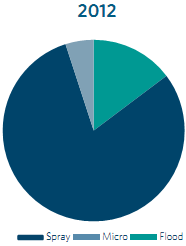
Also shown in the 2012 results of the Statistics New Zealand Agricultural Production survey, is a shift to more water-efficient irrigation schemes. Flood systems have decreased from 18% to 13%, conversely, more efficient spray and micro systems have increased.
Looking ahead, the numbers and the implications are very large - future irrigation potential ranges from 250,000 - 650,000 hectares and capital costs of up to $5b are discussed. Linking this to the projected changes in rainfall patterns from climate change and the importance of hydro for electricity generation, the importance of a well coordinated strategy to leveraging our natural competitive advantage becomes clear alongside the importance of the further stages of the Freshwater reform programme.