Urban water
The year As part of the water sector as a whole, urban water was assessed as the lowest rating of all sectors in the 2011 Plan. Key areas identified as issues were regulation and governance. The constraint of a lack of available information was particularly evident for urban water. Since then, there has been an extensive programme of work and reviews undertaken to improve the information base and strengthen the overall capability of the local government sector, including the management of infrastructure assets. The 2010 changes to the Local Government Act enabled a more detailed picture of urban water expenditure to be completed in 2012, this is a positive improvement although the level of detail is still high and consistency will improve over time. A further change from 2010 that will be seen in the 2015-25 long-term plans is the ongoing development of a set of standardised non-financial performance disclosure measures. These will focus on system adequacy, maintenance, environmental impact, and customer satisfaction, for the purpose of raising awareness among the local polity on the relative performance of their water systems. In March 2013, the Infrastructure Efficiency Expert Advisory Group reported. From this and the wider Better Local Government work programme, further changes are in process that will further contribute to the information base including: • the requirement for local authorities to undertake asset management planning and to develop a 30 year infrastructure strategy, reflecting the long life of the assets involved and the ten-year timeframe of the current published plans • standardised Balance Sheet disclosure statements on core assets in their 2013-14 annual reports Recent changes to key legislation (Resource Management Act, Land Transport Management Act and the Local Government Act) improves alignment and streamlining but it is recognised that more can be done. Capability across the urban water sector was highlighted as a concern, recognising the infrequency and scale / cost of many individual projects and the number of local authorities, spreading capability thinly. It is encouraging to see the increasing discussions across local authorities on strengthening this area, including increasing use of shared services models. Perhaps most pleasing over the past year has been the local authority ownership of the urban water issues and the specific steps the sector is taking to improve, including the LGNZ 3 Waters project and the establishment of a Centre of Excellence. |
Overview The Better Local Government work programme has continued to progress, including a large number of initiatives to improve the range and quality of information available to communities. Local authority planning processes will be streamlined and the sector is starting to focus on increased capability. |
Highlights from the past year » Implementation of more detailed and transparent financial forecasts in the 2012 long-term plans, enabling more detailed analysis to be undertaken across local government infrastructure assets and plans. » Completion of a number of reviews including Development Contributions, Efficiency Taskforce, Productivity Commission inquiry into Local Government Regulation and the Infrastructure Efficiency Expert Advisory Group. » New requirements announced for Councils to undertake asset management planning and develop a 30 year infrastructure strategy. » Changes to development contributions announced that record all infrastructure projects for which development contributions are (and are expected to be) collected, and the expected value of those projects. » Continued progress on developing non-financial performance measures (including those relating to the three waters) to be implemented in the 2015 long-term plans. » A performance monitoring and improvement framework is under development, focusing on building capability within the sector. » Launch of a LGNZ initiative focussed on strengthening the information base and capability of local authorities to manage and meet long-term infrastructure demands. | Opportunities/challenges » The challenge of delivering on the key themes of the Better Local Government programme and results of the reviews, especially in relation to: Strengthening asset management planning and practices and linking this to strategic decision making. Benchmarking and increasing accountability. Improving the information base relating to asset management and planned investment over the longer-term (beyond 10 years). Building local authority capability to manage and plan for long-term demand, including possible levels of investment anticipated over the next 30-50 years. » Better understanding the implications of the demographic change on infrastructure demands. » Taking opportunities to integrate, align and coordinate the planning regime across local and central government. » Facilitating and encouraging economies of scale for the delivery of water services through shared services arrangements or regional provision. » Forward planning of infrastructure needs to respond to changes - using all levers to maximise future investment including land-use, funding tools, demand management, urban design, shared services etc. |
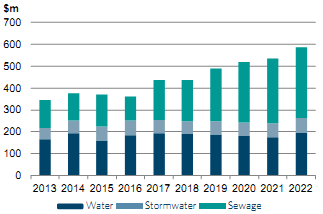
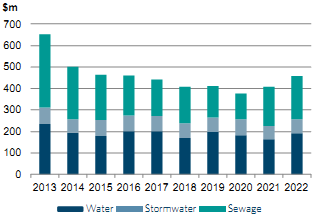
Auckland: 3 Waters forecast 10-year spend | Rest of NZ: 3 waters forecast 10-year spend |
|
|