Auckland
The year A major focus for the past year has been the development of the Auckland Unitary Plan (AUP) by Auckland Council. Initial public feedback was received on a pre-draft released in March 2013 and Council notified the proposed plan on 30 September. The AUP will be the principal means of applying the Resource Management Act 1991 in Auckland and the key tool to implement the Auckland Plan, which sets out the strategic direction for Auckland's growth over the next thirty years. It is important that the AUP supports the effective coordination of land-use and infrastructure planning, minimising investment delay and uncertainty, and facilitating the efficient allocation of land and infrastructure. Auckland Council's circulation of a pre-draft AUP needs to be commended, it was an extensive document produced in very short timeframes and had to balance a range of competing priorities and manage divergent views. Despite this, there is still scope to enhance integration. A major announcement in June was the Government's plan to kick start the next generation of major transport projects. The Government: • wants to speed up the combined Auckland Manukau Eastern Transport Initiative (AMETI), East-West Link and highway projects on the Southern and Northern Motorways and is taking advice on which elements can be accelerated and how funding can best be targeted • committed to a joint business plan for the City Rail Link with Auckland Council in 2017 and providing its share of funding for a construction start in 2020, and will consider investment in city centre bus access between now and 2020 • agreed that the next Harbour Crossing should be a tunnel and is likely to be needed between 2025 and 2030 The Auckland Council's Consensus Building Group has completed its work, starting with 20 different alternative funding options before analysis and consultation resulted in two options. The second includes road pricing to be in place by 2021. Rising house prices and the responding Housing Affordability work programme have also been a focus, linking to the AUP and land use. In Auckland, a Housing Accord has been developed between Auckland Council and the Government, with legislation to allow Special Housing Areas passed in September. The BBC framework has been promulgated within Auckland Council as means of determining the most effect interventions and value for money outcomes. The energy transmission network has been strengthened with advances made on securing the long-term supply and security of gas transmission, the completion of the North Island Grid Update Project and the North Auckland and Northland Grid Upgrade Project targeted for completion in December. |
Overview Good progress has been made on implementing the Auckland Plan and the development of the proposed Auckland Unitary Plan. Announcements have been made on housing and the next generation of transport projects but work remains on funding these and ensuring integration of land use, transport and the most effective utilisation of existing and provision of new infrastructure. |
Highlights from the past year » Auckland Council is actively applying the BBC approach to social sector and this same approach to transport projects (eg AMETI and East West link). » Auckland Council has commenced planning work for new Greenfield areas with key infrastructure providers. » UFB deployment 15% complete in Auckland and 69% complete in Northland. » Container volumes of 818,819 TEUs through the Port of Auckland with 4.4m tonnes of break bulk cargo and 1,463 ship calls. $14.9m of capital expenditure. » Vector Ltd distributed 8,332 GWh of electricity and as at 30 June 2013, had installed 505,888 smart metres. | Opportunities/challenges » Concerns remain over the ability of projects in the Auckland Plan to address long-term traffic congestion and issues, and for land-use objectives to be met through AUP policies and rules. » Finding appropriate balance between regulating land-use in order to control infrastructure costs (and/or using infrastructure planning as an investment signal), and allowing the market to determine appropriate locations for future development. » Further work around how the significant infrastructure required to cater for Auckland's growth can be funded both from private and public sectors. » Capability of Auckland Council and agencies to develop and deliver on the best co-ordinated value for money work programme. » Continuing development of appropriate responses to concern over the long-term outlook for gas transmission capacity availability in the Auckland region. |
|
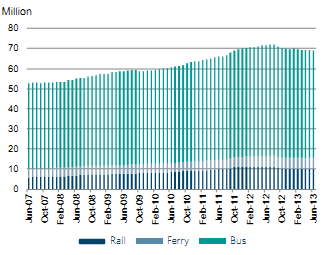
Auckland Transport | Total patronage 12 months rolling total |
|
|