What is a PPP?
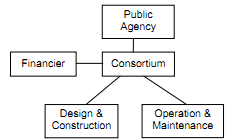
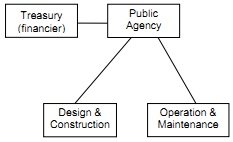
| PPPs are whole-of-life contracts for the financing, construction and operation of infrastructure facilities. | PPPs can take many forms, but the minimum characteristics of a PPP of the kind discussed in this paper are the following: • A public agency enters into a contract with a private company or consortium to provide finance and arrange design, construction and on-going operation of a facility ('on-going operation' might involve provision of full services or it might only involve providing maintenance of the facility, with services to the public being provided by a government agency); • The contract is typically for 20-30 years, or a substantial part of the life of • At the end of the contract, control of the facility is usually returned to the Typically, a government agency will specify the outputs or services required. The job of producing detailed designs, finding the finance, organizing the construction and on-going management of the facility is let to a private consortium by way of a competitive tender. The private consortium is typically organized by a lead contractor who brings together financiers, engineering firms, construction companies and facilities management companies, etc, to provide individual services. For a project to be a PPP as defined in this paper, all of these elements need to be carried out by the private sector. If coordination and financing are carried out by a public sector agency but, all other elements are carried out by the private sector, then the arrangement can be called "conventional private sector procurement". The following illustrates this distinction: | |
|
| Conventional Private
| |
|
This paper does not | To complete the picture, "public sector provision" describes the situation where the remaining elements, and in particular the operation of the infrastructure, are also carried out by a public sector agency. The point to note here is that public sector provision is not the only alternative to PPPs. Where a PPP is politically acceptable to the government, then presumably "conventional private sector procurement" will also be acceptable. Some of the advantages normally ascribed to PPPs, such as risk transfer, the introduction of private sector expertise and private sector performance incentives, are obtainable to a large extent also under conventional private sector procurement. It is not the purpose of this paper to evaluate conventional private sector procurement against public sector provision. The purpose of this paper is to evaluate the merits of replacing conventional private sector procurement with a PPP, i.e. to evaluate the distinction drawn in the above illustration. | |