... and reduces poverty.
Under the Millennium Development Goals (MDG), the country committed itself to halving extreme poverty from a 33.1 percent in 19911 to 16.6 percent by 2015. This goal can still be achieved provided that determined efforts are undertaken (Figure 1.2). Mass poverty remains the critical challenge, with the poor accounting for more than one-fourth (26.5%) of the population as of 2009. A deep cause for concern is the fact that the incidence of poverty has remained essentially stagnant for almost a decade now. Given the country's population growth, this actually means that the number of poor families and persons has been increasing through time. This again compares unfavorably with respect to some countries that have similar or lower per capita incomes (Table 1.2).
While poverty incidence did decline between 1991 and 2009, the rate of decline has been exceedingly slow. Indeed, there have been periods, such as between 2003 and 2006, when the poverty incidence actually increased despite above-average economic growth. This underscores the need for renewed efforts if progress in this area is to be sustained. For every percentage-point increase in income-growth in the Philippines, poverty incidence falls by about 1.5 percentage points compared with the range of 2.9 to 3.5 for high-performing economies (PR China, Indonesia, and Thailand)2 and the 2.5 average for a set of 47 developing countries3. Relative to international experience, therefore, Philippine economic growth thus, by far, has largely bypassed the poor.
Figure 1.2 Poverty Incidence and the Gini ratio: 1991, 2003, 2006, 2009
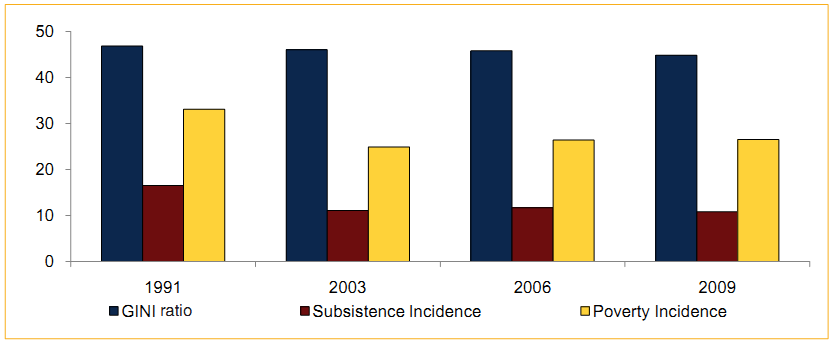
Table 1.2 Poverty and Inequality in selected countries (most recent available)
|
| Official poverty incidence in % (2007/2008) 1/ | Share of population below $1.25 per Day, % (2004/2005/2006/2007) 2/ | Gini Ratio | ||
| China | 4.2 | 15.9 | 0.415 | ||
| Indonesia | 14.2 | 29.4 | 0.376 | ||
| Malaysia | 3.6 | 9.0 | 0.379 | ||
| Philippines | 26.5* | 22.6 | 0.448** | ||
| Thailand | 8.5 | 2.0 | 0.425 | ||
| Vietnam | 13.5 | 21.5 | 0.378 | ||
Sources/Notes:
*2009 Official Poverty Statistics, NSCB
**2009 Family Income and Expenditures Survey (FIES), NSO
1/ 2010 ADB Key Indicators
2/ UN Economic and Social Commission for Asia and the Pacific (UNESCAP) 2009 Statistical Yearbook (www.unescap.org/stat/data/syb2009/)
Figure 1.3 Investment-to-GDP Ratios of selected Asian countries:
1994-2010 (in percent)
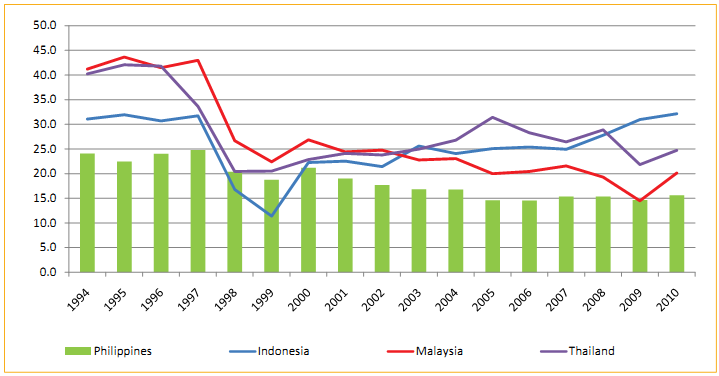
Note: For 2010, available data for Malaysia and Thailand are for Q1 to Q3 only.
Sources: ADB-Asian Development Outlook; Official Country Statistics websites; NSCB
A proximate factor behind the weak response of poverty to growth is high inequality. Compared to other countries in the region, income inequality in the Philippines is high (Figure 1.2 and Table 1.2). The Gini ratio, a measure of inequality, is in the mid-40s, whereas in Indonesia and Vietnam the Gini ratio is pegged at 38-39. Moreover, there has been no secular tendency towards falling inequality; movements in the Gini ratio have been erratic at best, declining in the early 1990s, rising until 2000, then falling slightly before leveling off at a still-high level by 2006. In general, it is safe to conclude that the trade-off between growth and inequality that is commonly observed in other countries still raises no policy dilemma in the Philippines, where low growth has been accompanied by increasing or high inequality.
_________________________________________________________________________________________
1 This uses the revised official methodology approved on February 1, 2011 by the NSCB. Under the older methodology, the poverty incidence for 1991 was 45.3 percent.
2 Cline, W.R. (2004), "Technical Correction," in Trade Policy and Global Poverty, Institute of International Economics, Washington DC. as cited in Balisacan, Arsenio M., 2007. Why Does Poverty Persist in the Philippines? Facts, Fancies, and Policies. Agriculture and Development Discussion Paper Series No. 2007-1. SEARCA, March 2007, pp. 10-11.
3 Ravallion, M. (2001), "Growth, Inequality, and Poverty: Looking beyond Averages," World Development, 29: 1803-15. as cited in Balisacan, Arsenio M., 2007. Why Does Poverty Persist in the Philippines? Facts, Fancies, and Policies. Agriculture and Development Discussion Paper Series No. 2007-1. SEARCA, March 2007, pp. 10-11.