…as are major gaps and lapses in governance,
Weak institutions and governance failures are the second major barriers to investment. On the positive side, with peaceful leadership-changes through orderly and credible elections, the nation has put behind it a period of political instability and deep mistrust of government actions, both of which were rooted in allegations of corruption in major economic projects and the perversion of vital political processes.
The advent of a new administration is an opportunity for government to regain the citizens' trust, lay bare the truth regarding past abuses, and instil civic vigilance for the future. But stability and a new atmosphere of openness and accountability are only the first steps in removing the governance-based fetters to investment and growth. A great deal more remains to be done in creating a governance climate that encourages massive investment and wins the people's support. The country continues to suffer from a reputation for bureaucratic inefficiency, excessive red tape, and widespread corruption. In the 2011 Doing Business ranking, for example, the Philippines placed 156th out of 183 countries. After three decades of trade-policy reform, it rated relatively well in "trading across borders". It rated poorly, however, for "starting a business", "closing a business", "dealing with construction permits", and "protecting investors", (156th, 153rd, 156th, and 132nd, respectively).
The country also ranks poorly in international comparisons of the enforcement of law and contracts, and competition measures. At the national level, contracting for and implementation of large public infrastructure projects are frequently stymied by difficult and nontransparent bidding and award rules that discourage wider private sector participation, promote collusion, encourage corruption, or provoke legal and other challenges from losing parties. Risks to large-scale investments can also arise from the bias, incompetence, or outright corruption on the part of some regulatory agencies and other oversight bodies, as well as lead to a culture of litigiousness, encouraged by misplaced judicial activism. Less sensationally but with not less damage, local governments impose their own share of arbitrary requirements and demands for corruption rents, which take a toll especially on the investment and employment decisions of many small-and medium-scale enterprises.
The country's long-standing problems with high electricity and construction costs are readily evident in global comparisons (Table 1.4). Such high costs are attributed to the lack of real competition in strategic sectors such as agriculture, maritime and air transport, power, cement, and banking. In some important cases, dominant firms and interests can exert enough social influence and political clout to limit entry. Many of these same sectors have dense backward and forward linkages, so that their failure to advance causes collateral negative effects in productivity growth and investment in the linked sectors, such as manufacturing (Bocchi, 2008). The threat of regulatory capture extends not only to the functions of agencies in the Executive branch but also to those exercising legislative and judicial functions that expand the scope of government.
Table 1.4 Strength of Bureaucracy and Input Costs in Selected Countries
| Country | Public Institution Index | Electricity (US$/KwH) | Building Construction Cost (US$/sq. Meter | Index of Ease of Doing Business (2010 Rank out of 183) | ||
| 2004 | 2009 | 2010 | ||||
| Philippines | 85 | 105 | 113 | 0.10 | 1022 | 144 |
| PR China | 0.08 | 97 | 89 | |||
| Malaysia | 34 | 30 | 43 | 0.07 | 282 | 23 |
| Hong Kong | ||||||
| Indonesia | 76 | 68 | 58 | 0.07 | 221 | 122 |
| S. Korea | ||||||
| Singapore | 1 | |||||
| Thailand | 37 | 57 | 60 | 0.06 | 329 | 12 |
| Vietnam | 0.07 | 93 | ||||
Sources: World Bank (WB), Doing Business 2006, 2007 and 2010 (www.doingbusiness.org)
MIGA and WB, Benchmarking FDI Competitiveness in Asia (2004)
In agriculture, meanwhile, investment has been stymied by continuing property-rights problems and inconsistent policy. Property rights in the countryside are also insecure. In the remaining areas under land reform coverage, for example, slow implementation creates uncertainty of ownership, both on the side of traditional landowners, and the new landowners, many of whom have yet to receive individual titles to their cultivated parcels. Likewise, private sector investment in some key crops is smothered by politicized decision-making of marketing and regulatory agencies, most prominently in the case of rice, which falls under the purview of the National Food Authority (NFA).
Ultimately, however, the cost of poor governance cannot be simply measured in peso terms. Its more pernicious consequence is the weakening of the civic spirit and the erosion of trust in the rule of law. The country is only now emerging from a recent past marked by public perceptions of impunity and unresponsiveness on the part of the highest officials of the land, where elections are stolen, public funds misappropriated, private interests promoted at public expense, public policy distorted to favor the few, and public officers who aggrandized themselves in the face of people's suffering - all without visible legal redress, social consequence, or material recompensation. The institutions meant as remedies to such conditions - the media, the courts, the political opposition, and the electoral process -were viewed as feckless, since many of them had either been cowed, co-opted, or corrupted. In such circumstances, it was unsurprising that people felt alienated from the political process and for cynicism to overcome their respect for the law. Growth in short was not inclusive owing to the basic disregard of the people's will and the failure to render "full and complete justice to all".
Figure 1.4 Cohort Survivaland Net Enrollment Rate, Philippines:
1990 - 2009 (In percent)
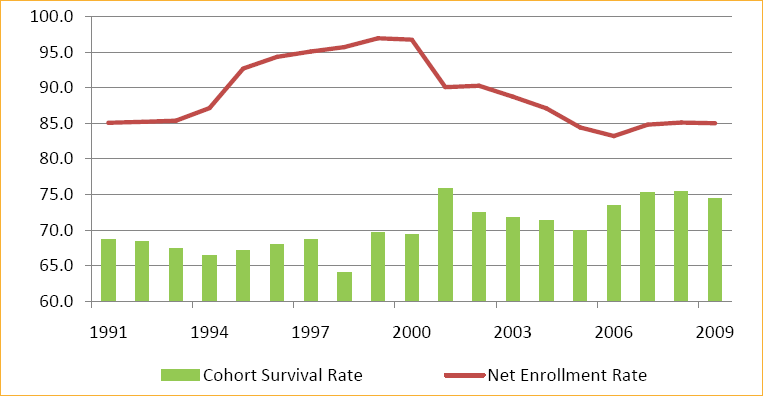
Source: SY 1991-1992 to SY 1998-1999, Department of Education (DepED) Statistical Yearbook; SY 1999-2000 to latest, Basic Education Information System (BEIS); Basic Education Statistics (Factsheet as of December 5, 2008); www.deped.gov.ph