Business Process Outsourcing (BPO)
The BPO industry is acknowledged as a driving force for economic growth and employment in the country. Two distinct drivers largely contributed to the growth of BPO demand: (1) increasing globalization which led to the lowering of barriers to trade that allowed companies to explore alternative locations to lower operating costs without sacrificing the quality of service; and (2) advancements in information and communication technology (ICT) which enhanced service delivery using the internet in a cost efficient and timely manner.
Typical outsourced services include the operation of human resources departments, telephone call centers, distribution centers, research needs, computer departments or services, and the design and/or engineering of components or end-products. The Philippines introduced BPO services in the country through the call centers or 'voice' services. However, the industry has evolved to higher value, non-voice BPO functions such as finance & accounting, human resource and administrative services, and transcription services. The years 2007 to 2008 marked the turning point and remarkable growth in the back office and knowledge process outsourcing (KPO) such as research, analytics and legal services; with more than two-fold growth in revenues from US$400 million to US$830 million.
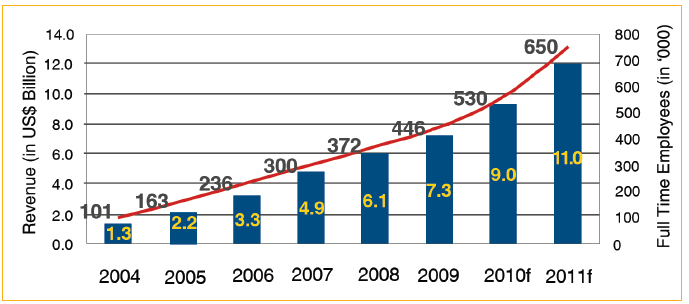
In 2010, the BPO industry has attained its US$9 billion revenue target while employing about 530,000 full-time employees (FTEs) (Figure 3.1). The US remains the prime source for outsourcing activities and opportunities for the Philippines as well as the major supplier of outsource work to the European and Japanese companies.
Because of its ready supply of professionals equipped with the required language skills, cultural affinity with the US and UK markets, and strong customer service orientation, the Philippines has gained considerable traction as a BPO destination. For the years 2007, 2008 and 2010, the country has been recognized by the National Outsourcing Association of UK and cited it as the "Offshoring Destination of the Year".
Figure 3.1. BPO/IT Outsourcing 2004-2011
Source: Business Processing Association of the Philippines
In 2010, the Philippines posted almost US$5.70 billion of pure voice-based revenues, which is even higher than India. Thus, in stand-alone voice business, the country ranks number one globally. However, India continues to be the leader in the global BPO industry mainly with its strong presence and capacity in information technology (IT) such as software development. On the supply side, while the country produces 480 thousand graduates per annum, the number of available workforce is undersized compared to India's 3 million talent pool. The country would need to enhance the capability of its professionals in the IT sector to capture opportunities from India's BPO market in the IT sub-sector.
Aside from labor resource, the country also needs to develop suitable locations to ensure that BPO investments and expansions can be accommodated. Physical and IT infrastructures are key solutions to address growth of the industry.
The National Capital Region dominantly houses majority of the BPO companies in the country. In 2009, the government and the private sector collaborated on a project dubbed as the "Next Wave Cities" wherein focus will be directed on locations with high-growth potential in the BPO services. Ten cities were identified namely: Davao; Santa Rosa, Laguna; Bacolod; Iloilo City; Metro Cavite (i.e. Bacoor, Dasmariñas, Imus); Lipa, Batangas; Cagayan de Oro; Malolos, Bulacan; Baguio City, and Dumaguete. In 2010, five cities are being eyed as BPO-potential destinations, namely: Dagupan, Legaspi, Metro Subic, Metro Naga, and General Santos.