Renewable energy
The "Renewable Energy Act of 2008," (RA 9513) sought to accelerate the exploration and development of the country's renewable energy (RE) sources. It also seeks to strengthen the DOE policies on renewable energy programs and expand the provision of fiscal and nonfiscal incentives to encourage private sector investment in the renewable energy industry. The Implementing Rules and Regulations (IRR) were signed on May 25, 2009. Consequently, the National Renewable Energy Board (NREB) was convened pursuant to Section 27 of RA 9513 to promulgate the said law and other related policy and regulatory mechanisms such as the Renewable Portfolio Standard (RPS), Feed-in Tariff (FiT) System and the National Renewable Energy Program (NREP).
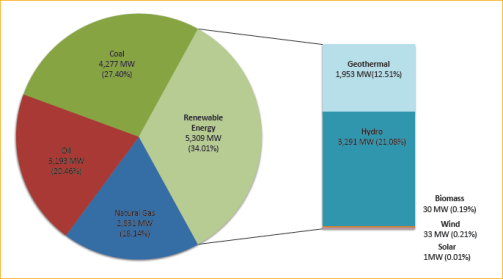
As of end-2009, total installed capacity from RE stood at 5,309 MW. Figure 5.6 shows the breakdown of the RE contribution to total power-generating capacity for on-grid areas. Total dependable capacity from RE resources for ongrid areas stood at 4,278 MW.
RE technologies are relatively expensive for local investors/developers. On the other hand, foreign investments have been slow to take up the slack because of the issue of project ownership, which is by law, stipulates majority Filipino ownership.
The goal of reducing fossil fuel consumption and promoting the development and utilization of renewable energy remains a major challenge. To benefit fully from RA 9513, government must institute certain changes, create new and additional units of infrastructure, and introduce new systems. Among the cross-cutting issues raised on renewable energy development during various energy consultations are the following:
Figure 5.6. RE Contribution to Total Power Generating Capacity: 2009
a. high cost of RE development due to limited number of local manufacturers, fabricators and suppliers of RE equipment and components which are mainly imported;
b. limited options to optimize the development of resources because of a lack of an up-to-date database on RE resources;
c. lack of capacity-building and training opportunities to enhance technical capabilities of stakeholders and potential developers;
d. need for stronger R&D on RE;
e. limited infrastructure support (i.e., transmission lines and submarine cables);
f. limited information and education campaign activities on RE that includes advocacy on its benefits;
g. absence of direct policy linkages with grassroots groups; and
h. dependence on government initiative and resources for the development of energy projects.