ICT Penetration (Access and Subscription)
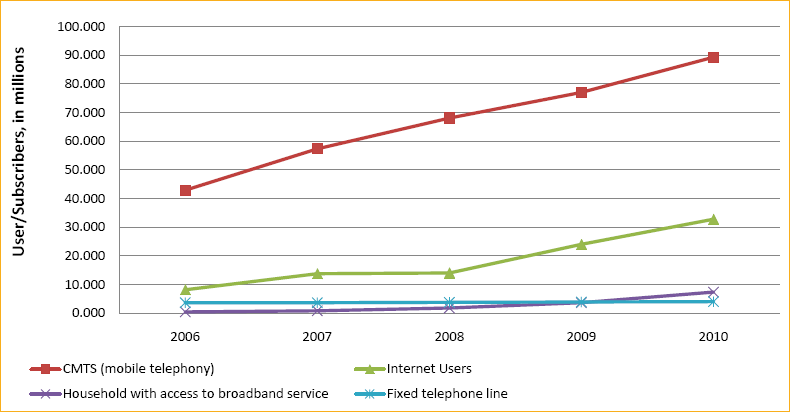
The increase in the number of CMTS subscribers has been phenomenal, especially as the short messaging service (SMS) or more popularly known in the country as "text messaging," has become a way of life for many Filipinos. Over two billion text messages (sending and receiving) are being handled daily by cellular mobile operators. More advanced services are also becoming prevalent, such as the multimedia messaging service (MMS) and the third generation (3G) mobile communication technology, which were rolled out in 2004 and 2006. The greater challenge, however, is for Internet, particularly broadband access and subscription, to also catch up and achieve the same level of service with that of mobile telephony, be it through wired (e.g., Digital Subscriber Line connection) or wireless broadband access (e.g., 3G/ High Speed Packet Access technology). Figure 5.7 shows signs of market concentration in the sector with the continuous growth in mobile telephony services, leaving other forms of ICTs such as Internet and broadband access far behind.
Figure 5.7. Growth in Number of Users/Subscribers of Major ICT Services: 2006-2010
In terms of Internet connection speed, a recent global broadband speed analysis test shows that the Philippines' average download speed (i.e, the speed at which data is sent from the Internet to your computer) is at 2.34 megabits per second (Mbps), while the average upload speed (i.e., the speed at which data is sent from your computer to the Internet) is at 0.65Mpbs.25 This ranks the Philippines at 72nd in worldwide download speed and 65th in worldwide upload speed.
At present, penetration of personal computers (PC) in the country is still considered low, especially in rural areas, which may be attributable to infrastructure limitations, availability of electricity access, and cost of ownership or household financial constraints. Since many Filipinos still do not own PCs, other alternative places such as Internet cafes, WiFi hotspots, offices, and schools, among others, serve as common Internet access points. There are currently some 30,000 to 40,000 registered Internet cafes and an estimate of 2,000 WiFi hotspots throughout the country. The increase in number of Internet cafes and the availability of free WiFi access in public spaces has led to competition and cheaper rates. Although PC ownership levels are quite low, utilization rates are much higher considering that the country's social networking penetration rate is at 83.1 percent, which is higher than the global average of 57.5 percent.26
The use of shared access facilities has also helped increase Internet usage, and made access to Internet services more affordable, especially in poor and underserved communities. Based on the concept of shared facility, the national government, in collaboration with LGUs has established the Philippine Community e-Center (CeC) Program, which to date has successfully connected over 1,200 communities to the Internet. The CeCs also serve as common access points for e-Government services.
________________________________________________________________________________________________
25 Source: Speedtest.net, 200
26 Source: Universal Mccann International Social Media Research Wave 3, March 2008