Assessment and Challenges
The country's recent history has been plagued by questions of legitimacy, accountability, and allegations of grand corruption. The 1986 EDSA revolution established a framework of constitutional democracy and civil rights, but deep social and political divisions have persisted alongside problems of inefficiency and corruption in government. The failure to address governance issues has given rise in recent years to marked political instability, bordering on threats to constitutional government, and a deepening cynicism and mistrust of formal political institutions. Political instability and widespread corruption have also had serious repercussions on the investment climate. The successful and credible transfer of power in 2010 through the prescribed constitutional processes and a renewed public concern for government accountability and transparency are important first steps in restoring the credibility of the nation's institutions. But they are not enough.
Efforts until now have at best created "islands of good governance"1 in certain sectors, some national agencies, and LGUs. But these have failed to translate into improvements in the country's overall state of governance, nor have any significant social impact. These "islands" are easily swamped by high tides of impunity and venality. The overall miserable state of governance in the country was attested by different measures. The country's percentile rank in the six dimensions of governance in the Worldwide Governance Indicators (WGI) until 2009 remained mostly within the lower half. The worst performance was in political stability, as the conduct and results of previous national elections were sharply contested amid allegations of corruption. The result was an alienation of the people from their government and an open invitation to several extra-constitutional attempts to seize power.
Figure 7.1. Philippines: Worldwide Governance Indicators
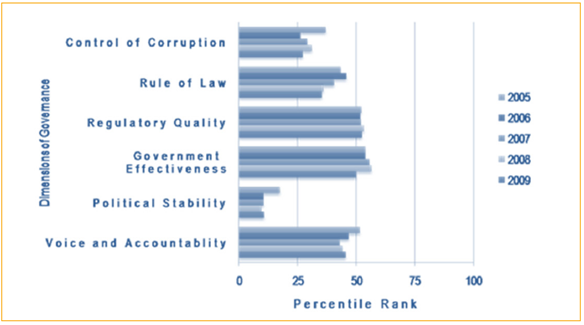
Source: World Bank (http://info.worldbank.org/governance/wgi/sc_chart.asp)
The country also failed to hurdle major indicators under the Millennium Challenge Corporation (MCC), which relies on the WGI for measuring policy improvements in three dimensions of governance.2 This picture is repeated in the Global Competitiveness Index (GCI), where the country was ranked 87th in 2009-2010 and 85th in 2010-2011.3 Even though the country's competitiveness slightly improved from last year, the country continues to lag behind most Southeast Asian neighbors. The Global Competitiveness Index Report for 2010-2011 listed corruption and inefficient government bureaucracy as the top two most problematic factors for doing business in the Philippines. The country's corruption problem is again highlighted in the 2010 Corruption Perception Index where the Philippines ranked below 75 percent of all the countries surveyed (134th out of 178 countries)4 and last among the ASEAN-6. The country's standing from all these measures signals the need for more substantial actions to strengthen governance in the country. This only shows that good governance cannot be achieved partially or piecemeal, but must be attained decisively and systematically.
Political instability, corruption, and weak rule of law have had severe negative effects on investment,5 which partly explains the country's low rate of capital formation. Public investment is stymied when corruption in revenue-collection efforts deprives the government of needed funds. Overpricing and funds-diversion in spending distort priorities and wastes public resources. But even private investment is affected; first, by the uncertainty of administrations whose legitimacy is questioned, and second, by the prospect and reality of biased rules and extortive practices, which raise the costs of doing business and discourage new business entrants and contract-bidders from providing real competition. In the end, the resulting poor growth and fiscal inability to support social programs severely impair poverty-reduction programs. Corruption and lack of transparency are major constraints to the achievement of the MDGs.6 To say that corruption and poor governance abet and worsen poverty is no exaggeration. Kung walang corrupt, walang mahirap.
______________________________________________________________________________
1 A phrase used by a former World Bank country director in an article of September 5, 2007.
2 The MCC is a bilateral grant program of the US. Eligibility criteria include 17 different governance measures, among which, however, the "control of corruption" is the only "hard" or strictly binding condition. When the Philippines transited from the low-income to lower-middle-income category in 2010, it fell below the threshold of the corruption indicator appropriate for the new peer group, with a 26th percentile ranking.
3 The Global Competitiveness Report 2010-2011 (World Economic Forum)
4 The Corruption Perception Index is a composite Report prepared by Transparency International which measures the perceived level of public sector corruption in 178 countries and territories based on 13 expert and business surveys.
5 Philippines: Critical Development Constraints (ADB)