Water is becoming scarcer...
The country is endowed with abundant water resources. It experiences an average annual rainfall of 2,400 mm. and has 421 river basins, of which 20 are major river basins ranging from 990 to 25,000 sq. km. The country's watersheds and aquifers, if fully functional, could supply 146 billion cubic meters (BCM) of water annually for domestic, industrial and agricultural uses. Total water availability is estimated at 126 BCM per year from surface water such as rivers or streams, and an estimated 20 BCM per year groundwater potential (NWRB 1998).
Although water is still abundant in certain areas, the country faces the threat of emerging water scarcity. Lack of urban planning, indiscriminate urban development, lack of investment in water, problems of water resource management, and the impact of climate change threaten water security and sustainability. Deforestation and lack of effective management of forest and freshwater ecosystems have led to the further deterioration of watersheds, limiting aquifer recharge and increases water runoff and soil erosion. Around 267 watersheds with a total area of 10.6 million hectares have been identified as needing immediate rehabilitation. These priority watersheds support national irrigation systems and are the major source of domestic water supply. Storage and distribution of water to deficient areas and proper water-resources management are also areas of concern.
Figure 10.1. Philippine Forest Cover, 1934-2003
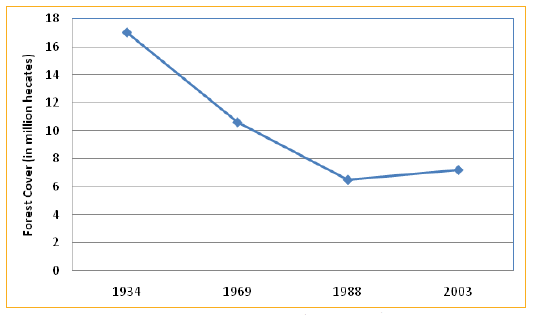
Source: World Bank (2009) and Forest Management Bureau (2010)
Increasing water demand has resulted in a number of regions and at least nine key urban centers experiencing water stress (NWRB 1998). These include Metro Manila, Metro Cebu, Davao, Baguio, Cagayan de Oro, Bacolod, Angeles, Iloilo, and Zamboanga. These highly urbanized cities rely mostly on groundwater for water supply, resulting in uncontrolled withdrawal from groundwater aquifers in recent years. Rapid and uncontrolled urban development has reduced aquifer recharge and has eventually resulted in the decline of groundwater levels as well as saltwater intrusion.
The 2010 Philippines' MDG Progress Report shows the proportion of the Philippine population with access to safe water has risen at a moderate rate, increasing from 73.8 percent in 1991 to 81.4 percent in 2008. If the trend continues, the 2015 target (86.9%) may be attainable. These favorable results, however, hide the fact that almost one in five (or 15.73 million) persons is still unable to access safe water despite abundant water resources.