1.1.2 Approval Phase
After the development stage, projects undergo the appraisal and approval process. Under this phase, proposed projects, depending on their scale and magnitude, are evaluated by the local and national approving bodies as described below
TABLE 2-1: Levels of Approval of LGU Project
Levels | Description |
President | • All Build-Operate-Own projects and other schemes not defined in Section 2 of RA 7718, subject to the recommendation of the NEDA Board's Investment Coordination Committee |
• Local projects costing above Php200 million • All unsolicited proposals regardless of project cost | |
Regional Development Council (RDC) | • Local projects costing above Php50 million up to PhP200 million |
City Development Council (CDC) | • Local projects costing up to Php50 million |
Provincial Development Council (PDC) | • Local projects costing above Php20 million up to Php50 million |
Municipal Development Council (MDC) | • Local projects costing up to Php20 million |
Source: Section 2.7 of the RA 7718
The BOT Law prescribes two implementation tracks: competitive bidding and unsolicited proposals. Each track has a distinct approval process. These approval processes are discussed in more detail in chapter 3 of this volume.
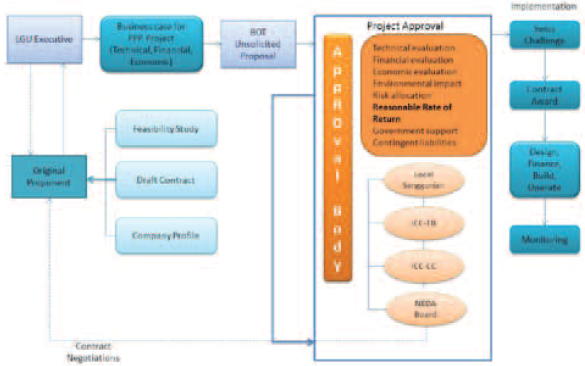
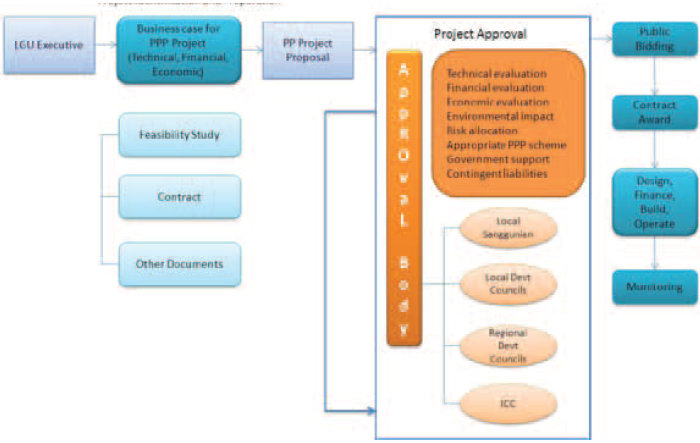
Competitive Bidding - Under this track the LGU is required to undertake identification of the project and preparation of the project proposal, and is responsible for: i) determining project feasibility; ii) securing project approval as defined in Table 2-1 above; iii) packaging the PPP project arrangement and conducting the public tender; iv) entering into the PPP contract; and v) monitoring the contract execution. The approval process for competitively-bid projects is shown in Figure 2-3 below.
Figure 2-3: Approval Process for Competitively-Bid Projects
Unsolicited Proposals - The process for unsolicited proposals also starts with project identification and preparation of the feasibility study, but these are undertaken by a private project sponsor. The latter is expected to submit company information that will be used for qualification; a feasibility study and the proposed contractual arrangement that will be used to evaluate whether to accept or reject the proposal. If the proposal is accepted the LGU will secure project approval as outlined in Table 2-1. The approving authority sets a reasonable rate of return and the negotiating parameters. The LGU then negotiates the project scope, implementation arrangements and terms of the contract with the private sector sponsor. If negotiations are successful the LGU goes back to the approving authority for final approval of the project. Upon approval the LGU then launches a Swiss challenge or price test. The Swiss Challenge is akin to a competitive bid. The only difference is that the original proponent is given the right to match the winning bid. The proponent is automatically awarded the contract if it is the winning bidder or if it is able to match the challenger's bid. The approval process for unsolicited proposals is shown in Figure 2.4.
Figure 2-4: Approval Process for Unsolicited Proposals