1. Construction provisions
PPP projects that entail construction must include the following either in the contract itself or as annexes: (1) detailed engineering designs, (2) adherence to construction works, (3) posting of performance guarantees, and (4) supervision of project construction. Construction provisions are clauses that apply during the construction phase of a PPP project. Two key issues to consider in construction contract provisions are the reopener clauses and the conditions for commissioning.
Reopener clauses refer to conditions in the contract that allow the private sector partner to renegotiate contract conditions (often affecting the price or completion date of the facility). Such conditions generally represent uncertainties in the project that cannot be fixed until construction has started. For example, ground conditions that affect the structure of the facility cannot be determined accurately until construction commences.
Box 2-2: Advantages and Disadvantages of Reopener Clauses
There are several advantages and disadvantages of including reopeners in the contract. Reopeners give the semblance that the signed contract is not final and that price can still be negotiated. This is generally politically unacceptable, especially if such reopeners are eventually exercised. The LGU may not be sure that it has actually obtained the lowest price during bidding. If reopeners are not defined well in the PPP contract, bidders can present low bids, knowing they can subsequently renegotiate at a later stage. Care must be taken that the contract will not be declared void due to substantial changes. |
Well-defined reopeners have several advantages. The foremost advantage is that they reduce the tendency of bidders to submit high bids. Without reopeners, bidders will increase the financial costs of their proposals to self-insure themselves against the additional risks they are asked to assume. The result is highly detrimental for the LGU concerned. If such risks occur, the proponent is covered by the higher bid. If such risks do not occur, then the proponent has windfall profit. |
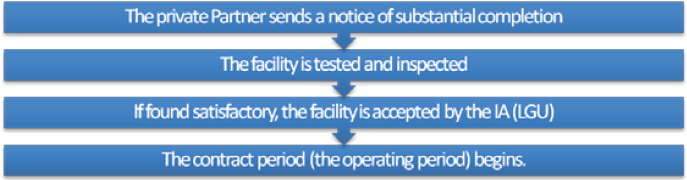
Conditions of commissioning are the clauses and specifications that define when the facility shall be completed and considered operational. LGUs should use clear and unequivocal language in the contract, specifying the following: (1) the term "substantial completion," (2) project milestones, (3) target completion date based upon meeting the requirements of substantial completion, (4) operating parameters, and (5) specifications which the completed facility must adhere to. The procedure for determining substantial completion is particularly critical. The general procedure starts with the issuance of a notice of substantial completion by the private partner and ends when the concession period begins, as illustrated in Figure 2-8.
Figure 2-8: Procedures Involved in the Conditions of Commissioning