1 Introduction

High quality economic and social infrastructure is vital to ensure Australia can maximise its productivity and maintain a high standard of living. It supports business and trade, connects people and places, fosters innovation, and enhances our quality of life.
Infrastructure Australia is mandated to develop plans for nationally significant infrastructure. Under its Act, 'nationally significant' infrastructure is defined to include the four sectors of transport, energy, telecommunications and water infrastructure.
Local, state and territory governments play critical roles in planning and providing infrastructure to their communities, and in certain cases work with the Commonwealth to do so. In addition to the economic benefits derived from our economic infrastructure, services such as health, education and recreation are delivered to Australians by social, cultural, sporting and environmental infrastructure assets.
The Australian Government has asked Infrastructure Australia to undertake two significant tasks. The first is to conduct an Audit of our national economic infrastructure. The findings of this Audit will form the basis for the second task - to develop a 15 year Australian Infrastructure Plan.
The Audit examines Australia's infrastructure assets and networks from a national perspective. This report records the findings of the Audit and seeks to answer a key question: where do we need to focus our attention to ensure that our infrastructure supports Australia's growth?
The Audit assesses the following infrastructure sectors and subsectors:
■ transport: with subsectors for urban transport networks, national highways, freight rail, ports and airports;
■ energy: with subsectors for electricity, gas and petroleum terminals;
■ water: with subsectors for water and sewerage facilities; and
■ telecommunications: including fixed line, mobiles and broadband.
For the first time, the Audit provides a 'top down' assessment of the nation's current economic infrastructure and the contribution it makes to Gross Domestic Product (GDP). It assess the value-add of the infrastructure sectors using the Direct Economic Contribution (DEC) measure (see Appendix 1). It also considers infrastructure demands and needs at both national and regional levels as we look ahead to 2031. Finally, based on available evidence, it identifies the gaps. This economic assessment is based on a range of assumptions to consider how, when and where demand for infrastructure services will change.
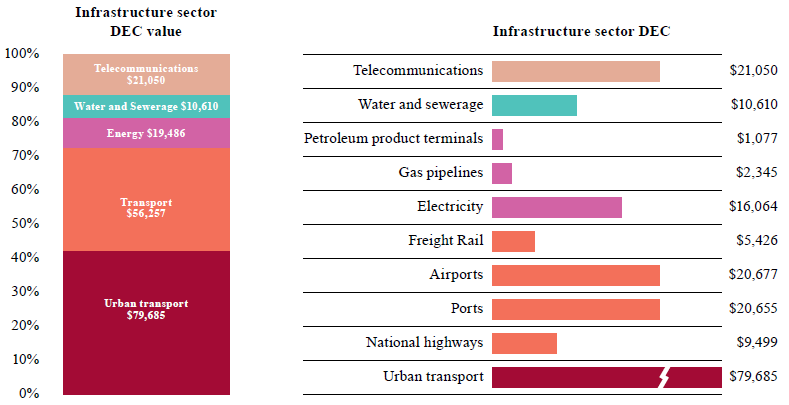
The analysis indicates the value-add from the four key economic infrastructure sectors (Figure 1) was approximately $187 billion in 2011,1 i.e. around 13 per cent of GDP.2 Based on a range of indicators, the Audit finds that Australia's infrastructure faces significant current and emerging pressures. Carefully planned and prioritised investment, as well as reform in broader infrastructure policies, will be necessary to maximise our national potential and living standards.
Figure 1: Sectoral distribution of infrastructure's value-add by Direct Economic Contribution (DEC) in 2011 ($ million, 2011 prices)
Source: ACIL Allen Consulting (2014a)
_________________________________________________________________________________
1. The base year for the Audit is 2011, which was selected because it was a national census year. There is therefore more complete and reliable data about infrastructure available for 2011 than is available for more recent years.
2. ACIL Allen Consulting (2014a)