2.3.1 Population growth
Australia's population in June 2011 was estimated at 22.3 million. In the three years to June 2014, the population grew by more than a million to an estimated 23.5 million.19
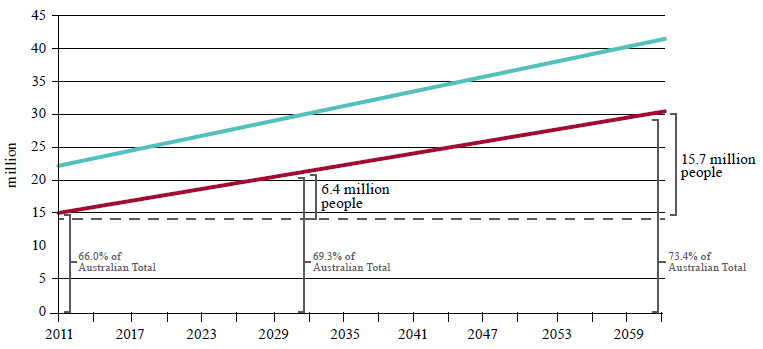
Australia's population is projected to grow significantly over coming decades. As shown in Figure 2, on medium level projections prepared by the Australian Bureau of Statistics (ABS), Australia's population is expected to continue to grow from 22.3 million in 2011 to 30.5 million in 2031, an increase of 8.2 million, or 36.5 per cent.20 Most state and territory governments take the ABS projections as the starting point for preparing their own projections, which then inform jurisdictions' strategies and plans.
The population projections used in the Audit and in the 2015 Intergenerational Report are similar. In the 2015 Intergenerational Report, Australia's population is projected to grow to 32.0 million in 2034-35. This is only 0.1 million (0.3 per cent) more than the equivalent ABS medium level projection - the basis for the Audit's projections - for the same year.21
In line with projections for other countries,22 the proportion of Australia's population living in the nation's capital cities is expected to grow.
The capital cities are projected to increase their share of the nation's population from around 66.0 per cent in 2011 to 69.3 per cent in 2031. In total, the population of the capital cities is projected to grow over this period by 6.4 million, from 14.7 million in 2011 to 21.1 million in 2031.
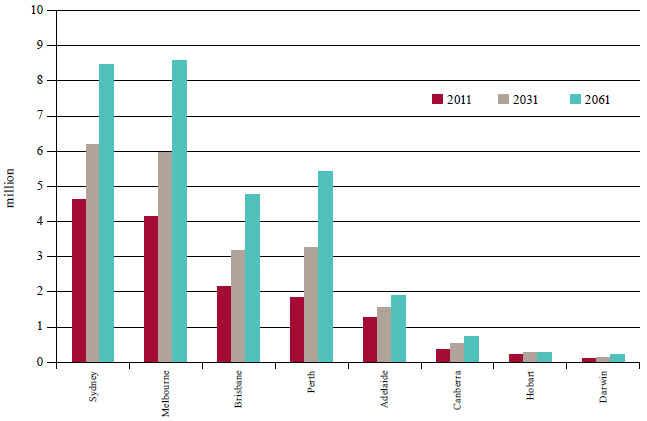
Most of this growth (91.8 per cent) is projected to occur in the four largest capitals - Sydney, Melbourne, Brisbane and Perth.23 In total, the four cities are expected to grow by 5.9 million people or 46 per cent.
Figure 2: National population projections - 2011 to 2061 (million)
 Eight Capital Cities - Total
  Australia - Total
Source: Infrastructure Australia (2015b), p. 21
Figure 3: Projected population of Australian capital cities - 2011 to 2061 (million)
Source: Infrastructure Australia analysis of Australian Bureau of Statistics (2013c) data24
This does not include population growth in urban areas immediately outside these cities such as the Hunter and Illawarra regions in NSW, the Gold Coast and Sunshine Coast in Queensland, and Geelong in Victoria. The population of these cities is projected to grow from two million in 2011 to 2.5 million in 2031. When combined, the population of these four greater metropolitan areas is projected to be 21 million in 2031, over two thirds of Australia's total population.25
This growth in population is likely to bring economic benefits. Research suggests that larger cities tend to have higher average per capita incomes than smaller cities.26 This is a result of agglomeration benefits, i.e. the tendency for firms in an industry to cluster in particular locations, which facilitates relatively easier exchange of innovative ideas, supplies and labour.
The larger capital cities have accommodated periods of strong population growth in the past, when per capita incomes were lower than they are now. This provides some cause for confidence that future growth can also be managed. That said, the anticipated scale of growth will test each city's infrastructure networks.
The other capital cities - Adelaide, Canberra, Hobart and Darwin - are projected to grow in total by slightly more than 0.5 million people or about 26.7 per cent. In percentage terms, Hobart and Adelaide are projected to grow the slowest of the capital cities. Darwin and Canberra are expected to grow more quickly, although off a somewhat smaller base population in 2011 compared to the larger capitals.
On the whole, the challenge of meeting the infrastructure needs of those cities is likely to be less significant than for the four larger cities. Indeed, it is worth considering what steps could be taken to foster growth in those cities and in regional centres so as to ease the pressure on our larger cities.
The population of Australia's regional areas is also projected to grow, from around 5.6 million in 2011 to 6.8 million in 2031, an increase of around 22 per cent.
Figure 3 illustrates the ABS medium level projection of population growth in Australia's capital cities. It needs to be emphasised that this is a projection - decisions by governments and others may lead to a different outcome. For example, recent interest in fostering development in Australia's north could see Darwin's population grow faster than current projections suggest.
Alternatively, increasing the population of Australia's regional areas could assist in moderating population growth in the largest capital cities.
Infrastructure decisions made over the next 15 years will also be influenced by evolving projections of population growth beyond 2031. The ABS medium level projections suggest that, over the period to 2061, Australia's population could grow to 41.5 million, with the combined capital cities' population growing to 30.5 million. The projected growth in the population of the capital cities between 2011 and 2061 (15.7 million) is larger than the combined population of all the capital cities in 2011.27
On these population projections, the larger cities will each need to provide for the development of around 500,000 to 700,000 dwellings over the next 15 to 20 years, and potentially over 1.5 million dwellings each over the next 40 to 50 years. Where and how that development will occur will be profoundly affected by the cities' existing infrastructure and the infrastructure decisions taken over the next five to 15 years.
Audit findings 5. Future demand for infrastructure will be directly affected by growth in population, broader developments in the local and global economy, technological change, the need for environmental sustainability and consumer preferences. 6. Population growth will drive a significant rise in the demand for infrastructure services. On medium level projections, Australia's population is projected to grow from 22.3 million in 2011 to 30.5 million in 2031 - an increase of 8.2 million or 36.5 per cent. 7. Almost three-quarters of this growth (72.0 per cent) is projected to be in the four largest capitals - Sydney, Melbourne, Brisbane and Perth. In total, these four cities are projected to grow by 5.9 million people, or 46 per cent, to 18.6 million in 2031. This growth will impose additional demands on urban infrastructure already subject to high levels of demand. 8. The other capital cities - Adelaide, Canberra, Hobart and Darwin - are projected to grow in total by slightly more than 0.5 million people or 26.7 per cent. Given this, it is worth considering what steps could be taken to foster greater long-term growth in those cities, which may moderate the consequential infrastructure challenges in the larger cities. |
_________________________________________________________________________________
19. Australian Bureau of Statistics (2014a). The population of Australian had grown to an estimated 23.6 million by the end of September 2014.
20. Australian Bureau of Statistics (2013c)
21. Australian Government (2015b), p. 99. The 2015 Intergenerational Report does not provide a population projection for 2031. Instead, it provides a projection for 2034-35. However, as the ABS provides annual projections of Australia's population to 2101 (at June 30 each year), it is possible to calculate an equivalent ABS projection for 2034-35. The ABS projections for June 2034 and June 2035 have been averaged to arrive at a 2034-35 projection (31.9 million).
22. United Nations Department of Economic and Social Affairs, Population Division (2014), p.1. The report observes, 'Globally, more people live in urban areas than in rural areas, with 54 per cent of the world's population residing in urban areas in 2014. In 1950, 30 per cent of the world's population was urban, and by 2050, 66 per cent of the world's population is projected to be urban.'
23. Although it is yet to update its official projections, the Western Australian Government has suggested that the ABS projections for Perth are higher than it considers likely.
24. The projections presented in the figure use the ABS's Series B (medium level) growth assumptions for the relevant Greater Capital City Statistical Area.
25. ACIL Allen Consulting (2014a). Projections prepared by the three state governments suggest that the population of these areas would increase to 2.7 million persons by 2031. The growth projections prepared by the state governments are: Lower Hunter (108,000 persons); Illawarra (65,000 persons); Geelong (95,000 persons); Gold Coast (308,000 persons); and Sunshine Coast (167,000 persons).
26. Glaeser, E. (2011)
27. Australian Bureau of Statistics (2013c). In the 2015 Intergenerational Report, the Australian Government projects slightly faster population growth over the long term than the ABS. The Government's projection of Australia's population in 2054-55 is 39.7 million - see Australian Government (2015a), p. 99. The Bureau's projection for 2054-55 is 39.2 million - see Australian Bureau of Statistics (2013c).