2.3.3 Productivity
Infrastructure can support growth in the economy through:
■ the formation of new capital (growth is maximised if the projects are themselves efficient); and
■ improving productivity in the economy.
Infrastructure can increase the overall productivity of an economy if it enables individuals, firms and industries to operate more efficiently. Similarly, improvements in the efficiency of infrastructure services can lead to productivity gains for those businesses and individuals who utilise the services. This occurs because of lower costs for the infrastructure they use as an input to production, or because the improvements in infrastructure allow businesses to produce their output more efficiently.
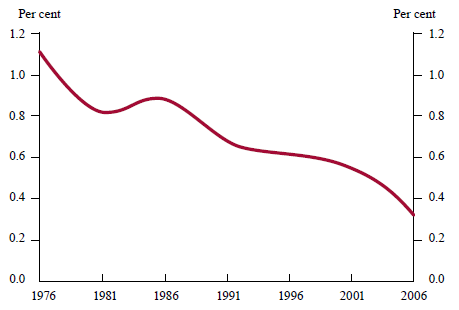
Changes in the rate of productivity growth in Australia reflect both global and local considerations. Globally, as shown in Figure 4, the rate of increase in productivity in the developed countries has been steadily slowing since the 1970s. Data from the World Productivity Database indicates that, with a few exceptions, the rate of growth in multi factor productivity (MFP) has been slowing since the early 1960s.30
Figure 4: Developed country multi factor productivity growth - 1976 to 2006
Source: Carmody, C. (2013)
Others have also highlighted a slowdown in the rate of productivity growth across the developed economies, albeit from a higher starting point.31 This difference reflects, among other things, limitations in historic and cross-country data on productivity.
The productivity performance of Australia has been relatively poor compared with other developed countries.
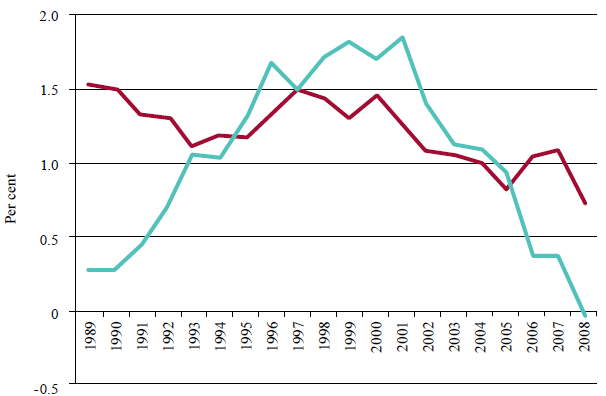
Figure 5 shows that the rate of MFP growth in Australia slowed considerably from 2000 to 2008. While this reflects a wider trend across 19 other OECD nations during this period, the Australian decline has been more dramatic than leading OECD nations.32
Although the OECD dataset for this specific measure has been discontinued from 2008, the trend in declining MFP growth in Australia appears to have continued to 2013.33 A number of other western economies had comparable or larger falls in productivity in the period 2007 to 2011, but the productivity performance of those countries has generally started to turn around. On the other hand, Australia's performance has not improved (in fact, it has deteriorated slightly).
The reasons for this sustained slowdown are varied and widely debated. Infrastructure features in many of those debates. The next section considers these matters in more detail.
Figure 5: MFP growth on a five-year moving average - Australia vs. 19 OECD countries - 1989 to 2008
|
|
 Australia
 19
19 Source: Infrastructure Australia analysis of Organisation for Economic Cooperation and Development (2013a) data
The 2010 Intergenerational Report stated, '… it is inherently difficult to project productivity growth over long horizons with any precision. This is because of the historical variation in productivity growth, and difficulties in measuring and explaining the range of factors which drive productivity'.34 Unsurprisingly, then, opinions differ on the prospects for turning around the fall in productivity, both locally and globally.
The 2015 Intergenerational Report assumes that productivity will grow over the coming 40 years at the same rate as the past 40 years, that is, 1.5 percent per year.35 The McKinsey Global Institute also argues there are plausible grounds for concluding productivity growth can be sustained at past levels. It suggests it should be possible to increase rates of productivity growth, both in the developed and developing economies. The Institute argues that diffusion of existing efficient business practices and technologies will drive most of this growth, while further technological and business innovations could push the 'frontier' of productivity growth.36
What stands out from the analysis is that pursuing productivity growth will be essential to maintaining growth in the Australian economy and average per capita incomes over coming decades. Globally, the demographic 'tailwinds' that have driven much of global economic growth over the last half a century are expected to taper. Improvements in productivity will therefore become an increasingly important driver of growth in the global economy.
_________________________________________________________________________________
30. Cited in Carmody, C. (2013). MFP can be broadly described as how efficiently labour and capital inputs can be transformed into outputs in the economy.
31. McKinsey Global Institute (2015), p. 44. The analysis suggests that compound annual growth rates in productivity fell from 3.2 per cent per year between 1964 and 1974, to 1.8 per cent per year between 1974 and 2004, and on to 0.8 per cent per year between 2004 and 2014.
32. Organisation for Economic Cooperation and Development (2013a)
33. Productivity Commission (2014b) citing work in Conference Board, The (2014)
34. Australian Government (2010), p. 14
35. Australian Government (2015a), p. 24
36. McKinsey Global Institute (2015), pp. 8-9