4.1.3 Intergovernmental relations
The responsibility for providing infrastructure spans across all levels of government, as well as the private sector, and increasingly involves national or cross-border considerations. This reflects the fact that various infrastructure networks traverse state/territory boundaries, or are of such scale or impact that many levels of government are involved.
Assessing the effectiveness of governance arrangements in infrastructure sectors therefore requires attention not just to individual organisations but to the interplay of multiple governments and organisations. The issues play out:
■ at a bi-lateral level between specific governments (for example, in relation to project priorities); and
■ multi-laterally between governments (for example in relation to broader regulatory and policy matters).
Sustaining long-term common interests between governments is an ongoing issue in Australia. Debates arise periodically about project priorities and funding responsibilities. Governments will understandably reach their own views about such matters, reflecting their strategic intentions and electoral commitments.
Nevertheless, there is a need to consider mechanisms that might support stable, considered efforts across the infrastructure sectors. Clear and regularly updated long-term plans, supported by detailed evidence, are an essential element amongst such mechanisms.
Broader regulatory and policy efforts often require some form of intergovernmental agreement. In this regard, members of COAG have periodically considered the effectiveness of the COAG arrangements, notably those relating to ministerial councils. Concerns have been expressed by some first ministers that efforts at reform agreed amongst first ministers were not progressing effectively through ministerial councils.80 At its meeting in December 2013, COAG rationalised the ministerial council system, establishing eight councils, including one dealing with transport and infrastructure.81
The Australian Government is currently undertaking a series of reform processes, which have identified potential policy and regulatory reforms that would impact on intergovernmental relations, with ongoing implications for the infrastructure sector.
It has committed to producing a White Paper on Reform of the Federation, which will consider the responsibilities of the federal and state governments. Issues papers released as part of the White Paper process suggest that social infrastructure will likely be the focus for reform.82 COAG agreed in October 2014 that the main focus of the White Paper process "will be on health, early childhood learning, schools, vocational education and training, housing and homelessness."83
The Australian Government has also committed to undertaking a taxation reform process. As part of this process, the Government has released a discussion paper,84 which calls for submissions addressing a fundamental question: whether each level of government has access to revenue bases sufficient to finance its spending decisions.
The discussion paper explains that taxation and spending arrangements in Australia's federation display a higher degree of 'vertical fiscal imbalance' than in other federated countries.
As shown in Figure 11, total payments from the Australian Government to the states/territories and local government totalled over $92 billion in 2012-13. This sum covers specific purpose payments (including for investment in and maintenance of infrastructure, especially transport and water), as well as general revenue assistance. In 2013-14, around 45 per cent of state/territory government revenues came from the Australian Government.85
Relevantly for the infrastructure sector, the discussion paper notes that some studies have suggested there could be economic gains associated with a reform of state taxes, particularly reducing stamp duties and making greater use of land taxes.86
Figure 11: Impact of Commonwealth grants on different levels of government - 2012-1387
|
|
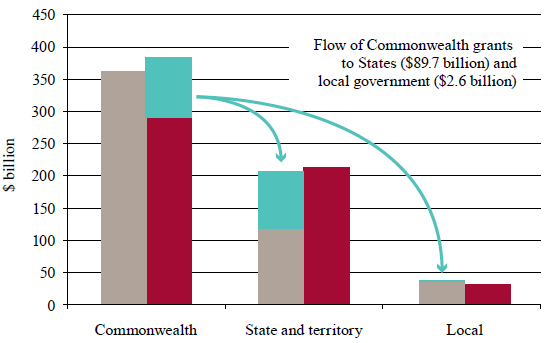
 Own-source revenue
 Own-purpose expenditure
 Commonwealth grants
Source: Department of the Prime Minister and Cabinet (2015b), p. 30
_________________________________________________________________________________
80. Lundie, R. (2011)
81. Council of Australian Governments (2013)
82. Department of the Prime Minister and Cabinet (2014b)
83. Council of Australian Governments (2014)
84. Australian Government (2015c). The discussion paper is a precursor to an options paper (a 'green paper') to be released later in 2015 and, in turn, a final tax plan to be released ahead of the next election.
85. Australian Government (2015c), p. 152
86. Australian Government (2015c), p. 143
87. Commonwealth payments comprise general revenue assistance (including GST) and specific purpose payments. Commonwealth financial assistance grants to local government are paid through states and territories, however, this has not been included in state and territory revenue or expenditure in the graph. State and territory expenditure and local government revenue also include State and territory grants to local government.