5.2.1 Planning for climate change
Adapting to climate change and pursuing sustainable environmental outcomes is a core responsibility of infrastructure planners, owners and operators. Meteorological and other evidence shows that the world's climate is changing due to man-made emissions of greenhouse gases, so transitioning to a lower emissions economy will be a priority task.
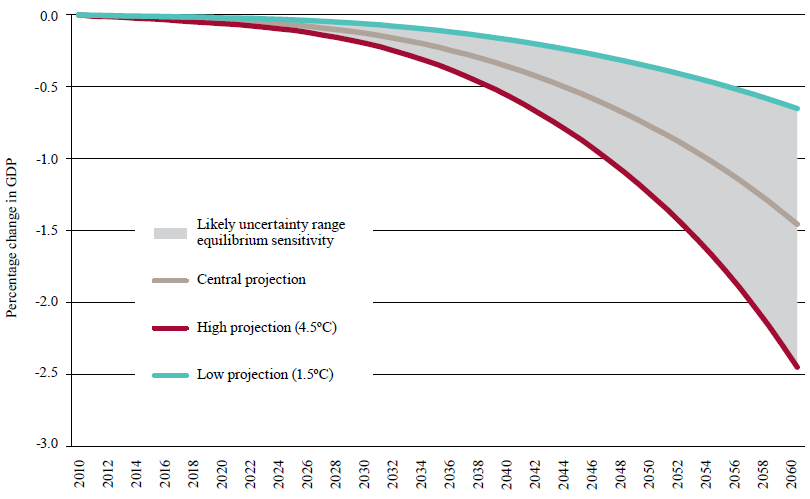
Organisation for Economic Cooperation and Development (OECD) modelling indicates that climate change may have a detrimental impact on future GDP growth. Figure 17 shows that annual GDP losses of between 0.7 and 2.5 per cent globally could be expected by 2060, with the greatest detrimental impact from decreased agricultural productivity and rising sea levels.
Figure 17: Climate change impact on global GDP based on temperature rise of 1.5°C to 4.5°C - 2010 to 2060
Source: Organisation for Economic Cooperation and Development (2015d)
The State of the Climate 2014 report by the CSIRO and the Bureau of Meteorology found that, compared to the period between 1980 and 1999, Australian temperatures are projected to increase by:
■ between 0.6 and 1.5°C by 2030;
■ 1.0 to 2.5°C by 2070 (for a low emission scenario); and
■ 2.0 to 5.0°C by 2070 (for a high emission scenario).139
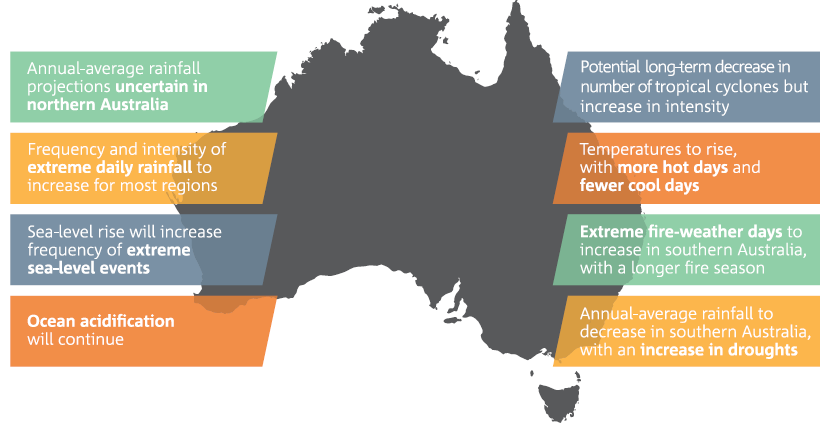
The report finds that average rainfall in southern Australia is projected to decrease, and droughts in southern Australia are projected to become more severe. Annual average rainfall projections in northern Australia are less certain. Although less rainfall is expected overall, the number and intensity of extreme rainfall events is projected to increase over most parts of Australia.
Audit finding 40. Adapting to climate change and pursuing sustainable environmental outcomes is a core responsibility of infrastructure planners, owners and operators. |
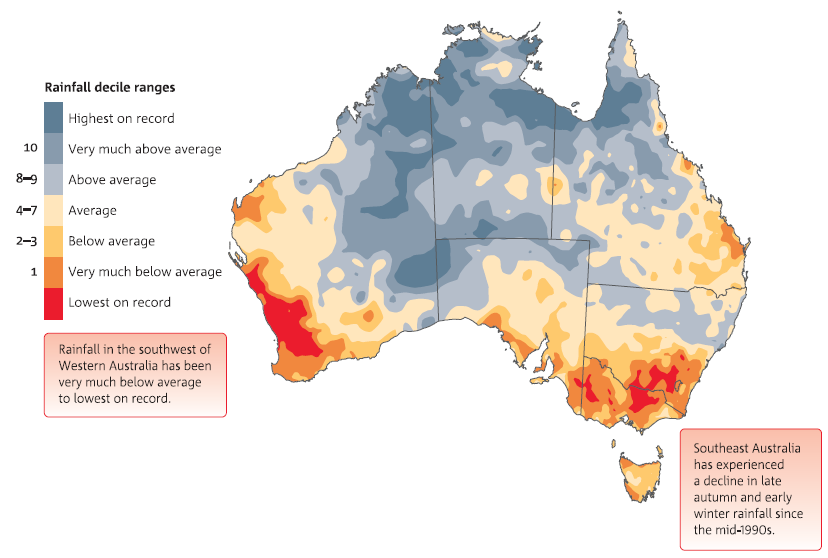
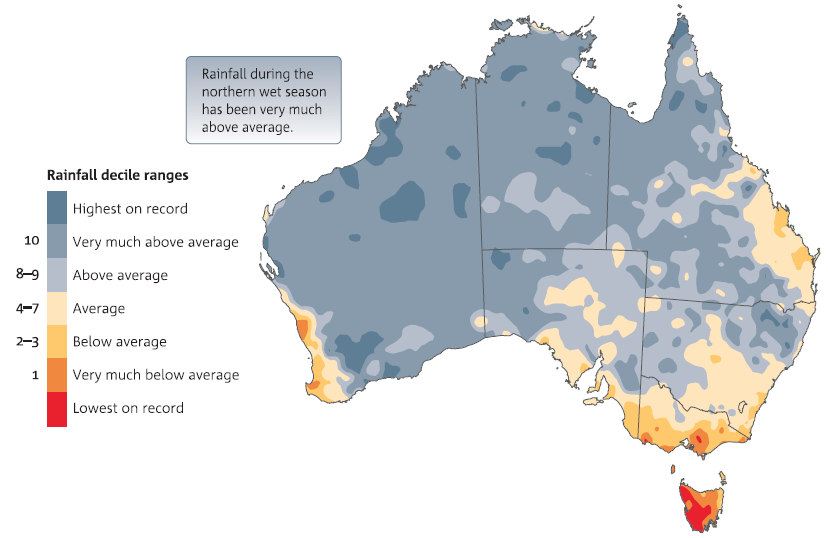
As illustrated by Figure 18, rainfall during the southern wet season - measured from April to November each year - was the lowest on record for parts of the southwest of WA and Southeast Australia over the period from 1996 to 2014. Much of Northern Australia experienced record high rainfalls. Figure 19 shows the recorded rainfall during the Northern wet season - measured from October to April - from 1995-96 to 2013-14. Figure 20 provides details of the likely outcomes of climate change, as projected by the Bureau of Meteorology and CSIRO.
Figure 18: Rainfall during the Southern wet season - 1996 to 2014
Source: CSIRO and Bureau of Meteorology (2014)
Figure 19: Rainfall during Northern wet season - 1995-96 to 2013-14
Source: CSIRO and Bureau of Meteorology (2014)
Figure 20: Forecast climate scenarios for Australia
Source: CSIRO and Bureau of Meteorology (2014)
The National Water Commission recently noted that more efficient use of water assets, including upgrading ageing infrastructure to minimise losses through leaks and breakages, will be required to better prepare the sector to withstand the increase in extreme events under climate change. Planning by water service providers and regulatory authorities should seek to minimise the impacts of water infrastructure on local habitats and existing agricultural assets.140
Audit finding 41. The projected decrease in rainfall (and the associated increasing exposure to severe drought) in the heavily populated southern parts of Australia presents significant challenges for the water sector. |
Sea-level rise and ocean acidification will continue, with projected rises around the Australian coastline of between 0.28 and 0.61 metres (under a low emissions scenario) and between 0.52 and 0.98 metres (under a high emissions scenario) by 2100. Under all scenarios, sea levels are expected to continue rising after 2100.
Compared with the climate of 1980 to 1999, the number of extreme fire-weather days is projected to grow in southern and eastern Australia by 10 to 50 per cent (under a low emissions scenario) and by 100 to 300 per cent under a high emissions scenario) by 2050.141
Fewer, but more intense, tropical cyclones are projected to affect Australia. However, the confidence in tropical cyclone projections is currently low.
_________________________________________________________________________________
139. CSIRO and Bureau of Meteorology (2014)
140. National Water Commission (2014d)
141. CSIRO and Bureau of Meteorology (2014)