6.1.1 Roads
The most economically significant roads are the national highways and major state arterial roads. These roads have high traffic volumes, and handle large numbers of trucks and other commercial vehicles. There is evidence of a maintenance deficit across many of these roads in all jurisdictions.
In October 2014 the Australian Government and the state and territory governments entered into National Partnership Agreements151 that:
■ recognise that, although certain national highways are owned by the states and territories, their maintenance 'is a joint responsibility and that road maintenance funding is required from both the Commonwealth and the states';
■ provide for Australian Government funding to the jurisdictions to be distributed on a formula basis that has regard to road lane length, total traffic volumes and heavy vehicle traffic volumes for non-tolled roads. Funding levels for 2014-15 to 2018-19 are shown in Table 5; and
■ preserve the existing state/territory responsibility for maintaining the relevant highways so that their condition is at least what it was in July 2013.152
Individual states and territories have periodically suggested that additional funding is required to maintain the roads in question to the required standard. This is an area that requires ongoing attention, both to avoid cost-shifting between different levels of government, and to minimise the possibility that maintenance funding for other roads is being reduced in order to fund contributions to maintenance of the agreed national highway network.
Most states and territories have ageing road and bridge assets that require rehabilitation and renewal in the near future to avoid:
■ significantly increased maintenance costs in the longer term; and/or
■ the imposition of service limits, e.g. weight and speed restrictions.
Table 5: Australian Government funding (2014-15 to 2018-19) for maintenance of highways on the defined National Land Transport Network ($ million)153
VIC | QLD | TAS | Total | |||||
529.5 | 278.9 | 446.8 | 139.5 | 232.2 | 36.5 | 83.8 | 2.8 | 1,750.0 |
Source: Infrastructure Australia analysis of Department of Infrastructure and Regional Development (2014c) data
Some jurisdictions, notably the New South Wales Government (NSW), have established programs to address bridge maintenance. The Australian Government is also contributing funds to bridge repairs. However, the scale of the task is substantial, and will require ongoing investment.
All jurisdictions need to direct attention towards improving whole-of-life asset management processes, and to ensuring adequate long-term funding strategies are in place for the road sector.
Rural roads owned and operated by local councils are important for local economic activity, and are an important part of the nation's transport network, providing the 'first and/or last mile' of many land-based supply chains. There is evidence of a maintenance deficit across many of these roads. This is a particular issue for local governments in rural areas with large road networks and declining income bases.154
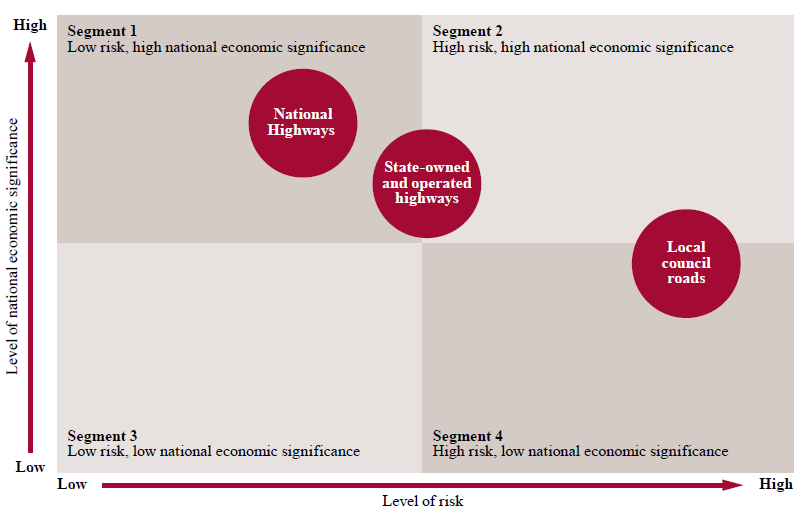
Figure 21 sets out a high level assessment of the national economic significance, and level of maintenance risk, of the different road categories.
Figure 21: Assessment of road maintenance
Source: GHD (2014), p. vi
_________________________________________________________________________________
151. Department of Infrastructure and Regional Development (2014c). The highways covered by the National Partnership Agreements are a subset of the highways considered in the Audit.
152. Department of Infrastructure and Regional Development (2014c)
153. Figures may not add up to the total due to rounding.
154. Allen Consulting Group (2009)