6.1.2 Rail
In the rail sector, maintenance investment and expenditure are linked closely to the level of demand.
Heavy haul rail, including the coal lines in Queensland and NSW and iron ore lines in Western Australia (WA), along with urban passenger networks, enjoy strong demand and have a higher economic priority than the majority of regional rail lines. Maintenance standards are generally high on the lines.
The interstate network, under the management of the Australian Rail Track Corporation, has benefited from significant investment in the last decade and is now maintained at a level broadly commensurate with its task.
Regional rail systems that are used for hauling lower volumes of predominantly grain, livestock and general freight are facing major challenges with respect to infrastructure maintenance. Much of the infrastructure is old, and has maintenance/ renewal issues including:
■ replacing wooden sleepers with steel or concrete sleepers; and
■ renewing/replacing timber bridges.
Local councils in regions served by these rail lines argue that poor maintenance of rail lines leads to more freight being transported by road, imposing additional maintenance burdens on the affected council. This has been an ongoing issue in relation to 'grain lines' in several states, notably NSW and WA.
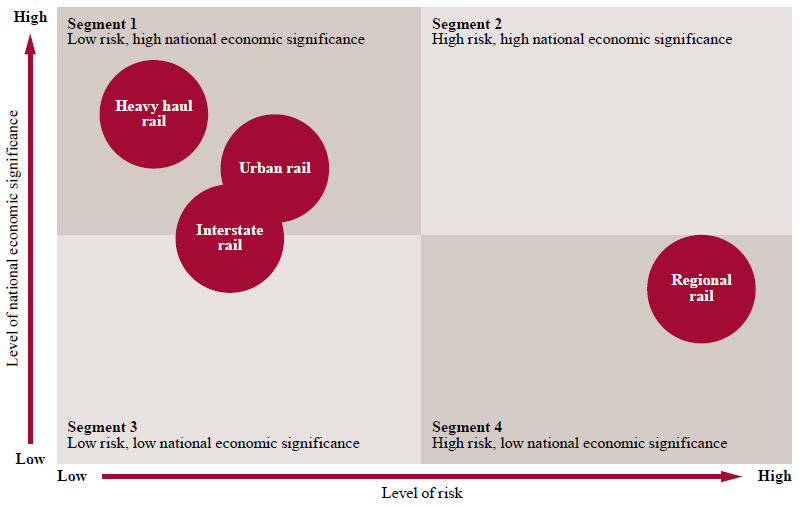
Figure 22 presents a high level assessment of the national economic significance, and level of maintenance risk, of each of the rail categories. It indicates that, in general, regional rail is more likely to be at a high risk of asset maintenance underspend. Regional lines with higher volumes, such as the Mt Isa to Townsville line which carries high-value minerals, are generally maintained to a higher standard than lower volume lines.
Figure 22: Assessment of rail maintenance
Source: GHD (2014), p. vii