7.1.3 Freight rail
Freight rail infrastructure is a key part of supply chains for bulk goods supporting mining and agriculture. Rail offers an alternative to road transport and societal benefits in terms of lower emissions, reduced road congestion and increased safety per tonne kilometre, particularly over longer distances or when carrying heavy goods.190
The Audit considers the value-add of 'below-rail'191 infrastructure used for freight rail services. Passenger rail services in the cities and major suburbs are estimated separately and included in the urban transport analysis. Passenger services on the interstate freight network, such as the Ghan, the Indian Pacific and country network passenger services are included in the Audit, but do not materially affect the results. The Audit should be viewed as largely reflecting freight infrastructure services.
The rail network reported in the Audit is shown in Figure 33. The shading depicts the value-add of rail services across Australia in 2011 by Audit region.
Figure 33: Freight rail network included in the Audit
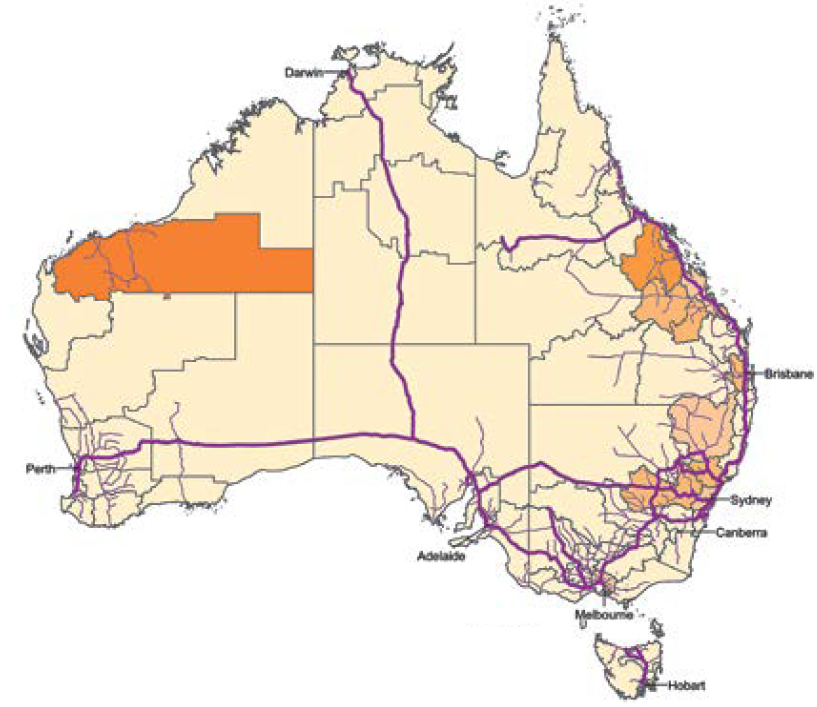
Rail 2011
|
|
 More than $2,000 million
 $500 to $2,000 million
 $100 to $500 million
 $10 to $100 million
 Less than $10 million
 National Land Freight Network
 Other rail
Source: ACIL Allen Consulting (2014a)
_________________________________________________________________________________
190. ACIL Allen Consulting (2014a)
191. Below-rail services are the services provided to rail transport operators, including the provision of rail tracks and associated infrastructure such as signalling.