7.1.3.2 Demand projections
Rail's share of the national freight task is expected to continue to grow over the period to 2031. A key driver of demand for rail services will continue to be the mining sector, with exogenous demand for Australian commodity exports expected to support significant growth in the rail freight task over this period.194 The total rail freight task is forecast to increase from 261 billion tonne kilometres in 2011 to 497 tonne kilometres in 2031.195
The Audit projects that DEC for rail freight services will grow to $9.5 billion in 2031. This represents an increase of $4 billion, or 74 per cent, from 2011.196
Projected growth in GDP over the same period is 84 per cent. The slightly slower growth in the DEC of rail services may be attributable to the increased productivity of rail - that is, the output of the rail industry is expected to grow but the margins for service providers are likely to decline.197
As illustrated by Figure 35, the growth in DEC for rail infrastructure services from 2011 to 2031 will be focused in NSW, Queensland and WA, owing largely to the growth of the freight task associated with mining and manufacturing operations in those states.
Figure 35: Growth in DEC for rail infrastructure services - 2011 to 2031 (2011 prices)
|
|
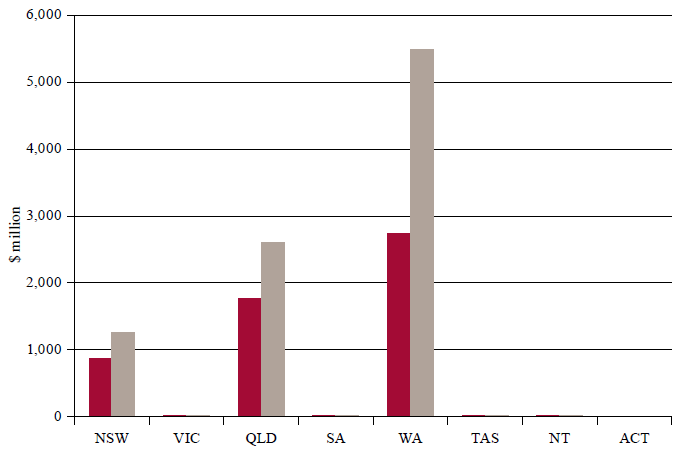
 2010-11
 2030-31
Source: ACIL Allen Consulting (2014a)
_________________________________________________________________________________
194. Department of Infrastructure and Regional Development (2014d)
195. Bureau of Infrastructure, Transport and Regional Economics (2014b)
196. ACIL Allen Consulting (2014a)
197. ACIL Allen Consulting (2014a)