7.1.4.2 Future demand
Growth in demand for port services in Australia over the period to 2031 is expected to be driven by the growth in demand for Australia's exports, particularly in the mining and resources sector. Forecast strong population and economic growth in China and throughout South-East Asia will ensure that Australia's ports remain an integral part of the national economy.
Population and economic growth within Australia will also support growth in demand for port services, as the demand for largely containerised imports will increase.
The DEC for each port reflects the tonnage moved through it and the relevant share of the gross value added in the region. However, bulk ports form a link in the wider supply chain, and maximum throughput requires efficient and matched railway networks and shipping channels.
The DEC for port infrastructure services in Australia is expected to grow to $41.9 billion by 2031, meaning that this figure will more than double from 2011, when it was $20.7 billion. This represents an annualised growth rate of 3.6 per cent over the period from 2011 to 2031.206
As illustrated by Figure 37, WA is forecast to experience the strongest growth in DEC over the period, with an increase of 216 per cent. This is expected to be largely driven by the growth of port services in the Pilbara region, to support dramatic growth in the commodity export supply chain. The DEC for ports in the Pilbara region is forecast to grow from $1.8 billion in 2011 to $8.3 billion in 2031.
Figure 37: Growth in DEC for port infrastructure services - 2011 to 2031 (2011 prices)
|
|
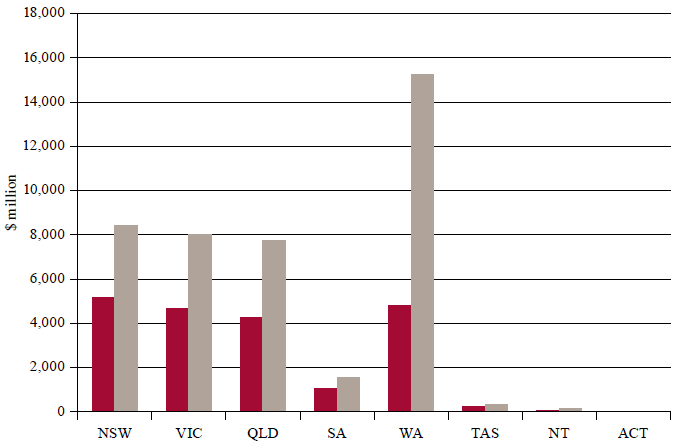
 2010-11
 2030-31
Source: ACIL Allen Consulting (2014a)
_________________________________________________________________________________
206. ACIL Allen Consulting (2014a)