7.1.5.1 Existing capacity
In total, Australia's airports facilitated 146.5 million passenger movements in 2013-14. Total passenger movements, encompassing those on scheduled domestic, regional and international flights, was highest at Sydney Airport (38.6 million), followed by Melbourne Airport (30.9 million) and Brisbane Airport (21.8 million).209
Airport capacity can be characterised as the maximum throughput of passengers per unit of time. This measure depends on:
■ aircraft type;
■ number, length and material of runway;
■ terminal size and design;
■ air traffic control facilities; and
■ external constraints, such as aircraft movement caps, curfews and noise abatement procedures.
However, there is no single straightforward measure of the practical capacity of an airport.210 Demand for airport infrastructure services can vary significantly across peak and non-peak periods, while other factors including weather conditions and environmental constraints have an impact. For some airports, the airside infrastructure may be able to handle a far greater capacity than the terminal infrastructure or supporting transport links, resulting in bottlenecks for passenger and cargo flows.
Australia's biggest airports, such as Sydney (Kingsford Smith), Melbourne (Tullamarine) and Brisbane, are currently at or near capacity during peak periods. An increase in air services to support the resources sector has placed some regional airports under significant pressure to meet growing demand.211
The DEC for Australia's airport services in 2011 was estimated to be $20.7 billion. This equated approximately 1.6 per cent of GDP.
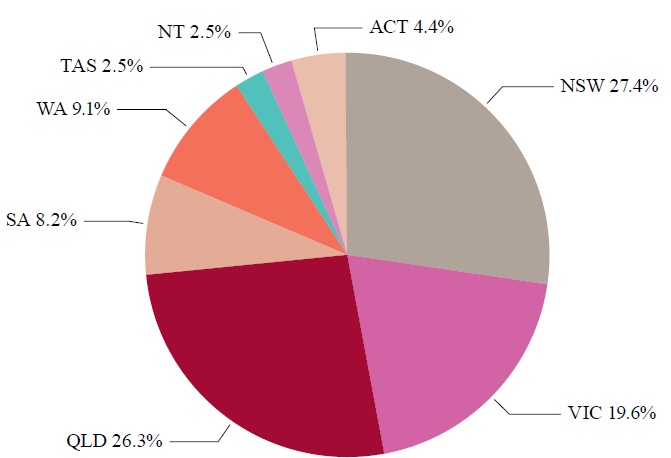
Figure 38 shows the share of value-add of airport services in each of the state and territories in 2011, measured by DEC.
Figure 38: Share of value-add for airport infrastructure services by state and territory in 2011, measured by DEC
Source: ACIL Allen Consulting (2014a)
_________________________________________________________________________________
209. Bureau of Infrastructure, Transport and Regional Economics (2014i)
210. Australian Government and New South Wales Government (2012)
211. Bureau of Infrastructure, Transport and Regional Economics (2012b)