7.3.2 Projected demand
Demand for telecommunications services will continue to grow at a rapid rate over coming years, driven by increasing connectivity, the growth of new services and the cultural changes associated with increased use of social media. A broad range of services and processes are now being delivered online, and are dependent on telecommunications infrastructure.
The number of internet-connected devices is projected to increase exponentially over the medium-term. Advances in machine-to-machine (M2M) communication, involving collection of data through digital sensors, is creating the so-called 'internet of things'. Always-on/always-connected access to communication infrastructure will enable these technologies to grow - potentially generating cost savings and productivity gains across industries and households.
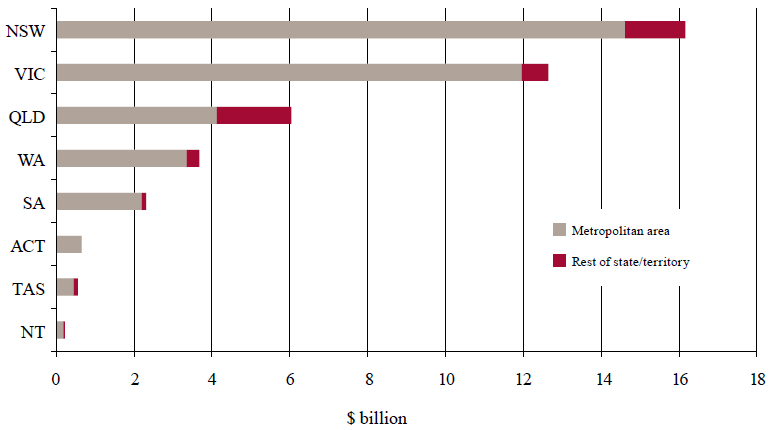
As a result of these trends, the value-add of the telecommunications sector is expected to grow faster than GDP. The DEC of telecommunications services across Australia in 2031 is projected to be approximately $42 billion, an increase of 101 per cent from 2011. Figure 42 illustrates the projected DEC for each jurisdiction and capital city. The vast majority of the DEC of telecommunications infrastructure is accounted for in the capital cities.
Figure 42: Projected DEC of telecommunications services by state/territory and metropolitan areas in 2031 ($ billion, 2011 prices)
Source: ACIL Allen Consulting (2014a)
Growth in demand is already occurring. There is likely to be a continued increase in demand for high-capacity broadband infrastructure over the next five years, reflecting a growing demand for data that includes video content. Cisco Systems forecasts that video traffic will account for 79 per cent of all global consumer internet traffic in 2018, up from 66 per cent in 2013. Streaming entertainment content, such as Internet Protocol Television, accounted for 67 per cent of peak period downloads in North America in September 2014. One content provider, Netflix, accounted for over half of the streaming content downloads, and also represented 34.9 per cent of all peak period download traffic. The download traffic generated by Internet Protocol Television may expose the limitations of the current broadband network in some areas, although development of the NBN should help mitigate this.
Mobile data usage in Australia is projected to increase almost four-fold from 2013 to 2017. Total cellular data usage is projected to grow at an annual rate of 38 per cent, from an estimated monthly average of 22.2 petabytes in 2013 to 81.1 petabytes in 2017, constituting a 265 per cent increase over this period. 4G data traffic is expected to account for most of the growth in overall data usage, with an annual growth rate of 76 per cent between 2013 and 2017.
Audit finding 70. Demand for telecommunications infrastructure will continue growing rapidly across the nation, faster than GDP growth. |