1.8.2 Riverina and Murray regions
Forty per cent of water supplied in NSW is for irrigation enterprises in the Riverina and Murray regions. The projected growth in DEC for water and sewerage in these regions is $35 million, from $215 million in 2011 to $250 million in 2031.
Water NSW is the primary supplier of bulk, untreated water to regional towns and for irrigation activities such as horticultural, pastoral, agricultural and silvicultural enterprises.
Privately owned irrigation companies and trusts in these regions have bulk water licenses to extract water and supply it via open channel and low pressure pipe distribution systems to customers.
In the irrigation sector, demand will continue to be influenced by water availability and macroeconomic factors such as commodity prices, market access and exchange rates. Other factors that will have an impact on future demand include more efficient irrigation technology and practices and the extent to which new greenfield irrigation areas are established.
In 2008, the Australian Academy of Technological Sciences and Engineering (ATSE) noted that:
The most significant impact from the climate change scenarios is drought in the more southern regions of Australia. The capacity of storages and the effectiveness of distribution systems required to survive extended periods of drought are seen as a high to extreme risk with effective adaptation capacity requiring major investment and national strategic planning.
Figure 57: Forecast water supply deficiency for local water supply utilities in 2036
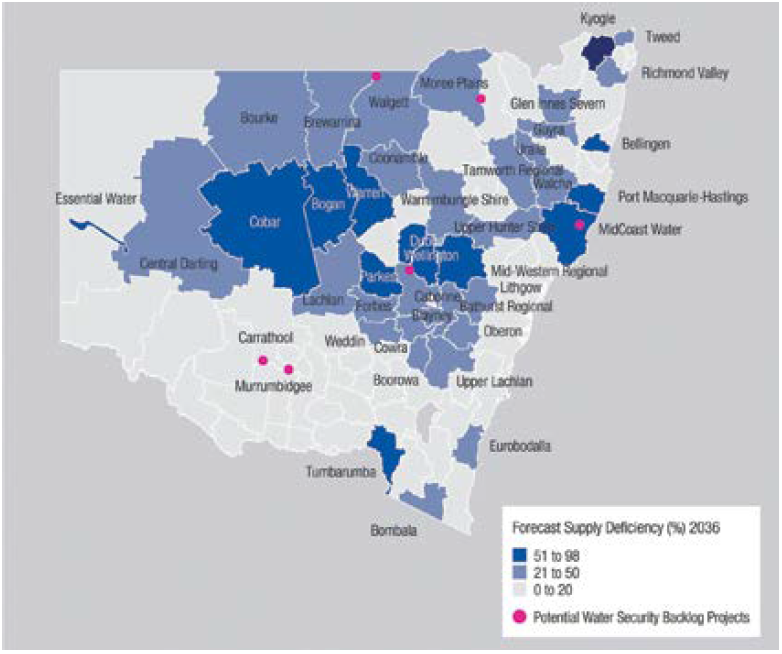
Source: Infrastructure New South Wales (2014), p.95
The Agricultural Competitiveness Review aims to support strong and vibrant regional communities, build the infrastructure of the twenty-first century and reduce unnecessary regulation at all levels of government and give greater ownership and rights to farmers.303
The SISU included a map of predicted rainfall changes to 2050 which shows a rainfall seasonality shift to summer dominance in the Riverina region and a significant loss in winter rainfall, with a small increase in summer rainfall in the Murray region.
Opportunities for augmentation of supply are limited in the Murray Darling Basin, as the resource is already overcommitted. Consequently, increased demand will need to be met through improved efficiency and water trade. The Basin Plan sets out the schedule for achieving sustainable levels of use through water buy back and investment in water saving infrastructure.
___________________________________________________________________________________________________
303. Australian Government (2014b)