2.2 Drivers of infrastructure demand - population and economy
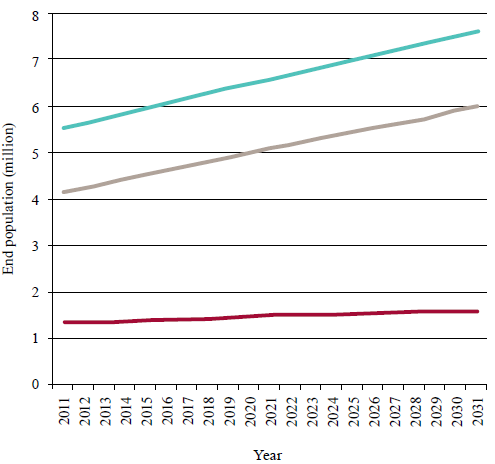
Based on medium level projections from the Australian Bureau of Statistics, the population of Victoria is projected to reach 7.6 million in 2031 - an increase of 2.1 million people, or 37 per cent, from 2011. The Victorian Government projects that the state's population will grow slightly faster than this, to around 7.7 million by 2031.306
As shown in Table 42, the Victorian economy is expected to grow by around 75 per cent over the 20 years to 2031. This is a slightly slower rate of growth than the country as a whole, reflecting the higher rates of growth expected in WA and Queensland. As a result, Victoria's share of the national economy is set to fall modestly, although it will remain the second largest of all the jurisdictions.
Table 42: Projected population and economic growth for Victoria
| 2011 | % of National | 2031 | % of National | Increase % | |
| Population (persons) | 5,537,817 | 24.8% | 7,584,869 | 24.9% | 37% |
| Gross State Product ($m) | 312,834 | 22.2% | 550,015 | 21.3% | 76% |
Source: ACIL Allen Consulting (2014a)307
Figure 58: Population projections for Victoria - 2011 to 2031
|
|
|
 Greater Melbourne
 Balance of
  Total
Total Source: Australian Bureau of Statistics (2013c)308
As shown in Figure 58, most of Victoria's population growth is projected to be in Melbourne. Both the Audit and the Victorian Government project Melbourne's population will increase by 1.8 million.
Population growth in Melbourne is projected to be strongest in the inner city, South Casey, Cardinia, Sunbury, Whittlesea-Wallan, Tullamarine-Broadmeadows, Melton-Bacchus Marsh and Wyndham. Major employment centres are projected to be in Melbourne inner city, Essendon, Yarra, Brunswick-Coburg, Darebin North, Brimbank, Casey South, Cardinia and Whittlesea.
___________________________________________________________________________________________________
306. Victorian Department of Transport, Planning and Local Infrastructure (2014e)
307. Gross State Product is in 2010-11 prices.
308. Series B (medium level) projections.