2.8.1 Greater Melbourne region
Greater Melbourne consumed 400 GL of drinking water in 2013-14.344 During the recent drought, Melbourne's residents and businesses reduced their consumption substantially from the 10-year average of 500 GL (annual average from 2000-01 to 2011) to 343 GL (in 2011) - a reduction of approximately 30 per cent.
Household consumption accounts for 63 per cent of Melbourne's drinking water use. Non-residential water use accounts for about 26 per cent and the remaining 11 per cent is categorised as 'nonrevenue water', which includes loss of water from mains bursts and leaks, water used for fire-fighting and mains flushing, and water theft. This demand is met by Melbourne Water, the bulk water provider, and three retail water businesses (City West Water, Yarra Valley Water and South East Water).
Melbourne Water is the wholesale supplier of Melbourne's drinking water, recycled water and wastewater to three retail water corporations: City West Water, Yarra Valley Water and South East Water.
Melbourne Water's supply system comprises 157,000 hectares of protected catchments in the Yarra Ranges, 10 storage supply reservoirs and 38 service reservoirs located around suburban Melbourne with a combined total capacity of 1,812 GL. Water is treated through its 34 water treatment plants and supplied through its 1,057 km of water mains, 214 km of aqueducts, and 64 service reservoirs (including the currently decommissioned North-South Pipeline, formerly known as Sugarloaf Pipeline, which is a 70 km pipe that can carry water from the Goulburn River to Melbourne's storages at Sugarloaf Reservoir). The Winneke Treatment Plant in Christmas Hills is the major water treatment plant in Melbourne and provides up to 50 per cent of Melbourne's daily water needs. It is connected to Sugarloaf Reservoir, which receives water from Maroondah Reservoir and the Yarra River. In response to the recent drought the Victorian Government commissioned the 150 GL capacity Wonthaggi desalination plant owned and operated by AquaSure.
Each year Melbourne Water removes and treats more than 320 GL of sewage, which represents the majority of Melbourne's sewage (including trade waste), via its network of more than 400 km of sewers, nine pumping stations, two treatment plants (the Eastern Treatment Plant at Bangholme and the Western Treatment Plant at Werribee) and nine air treatment facilities. In 2013-14, the Eastern Treatment Plant produced 18 GL of recycled water, 12 GL of which was used onsite, with 4.5 GL supplied to the Water Infrastructure Group and 1.2 GL to South East Water. In the same year the Western Treatment Plant produced 12 GL of recycled water, 9.4 GL of which was used onsite (mostly Class C) for pasture irrigation and salinity management by the agricultural business MPH Agriculture.
Melbourne Water and local councils share responsibilities for most of Melbourne's drainage system. Melbourne Water is responsible for the installation and maintenance of more than 1,400 km of the regional drainage network, including large drains and stormwater infrastructure connecting with rivers, creeks and bays.
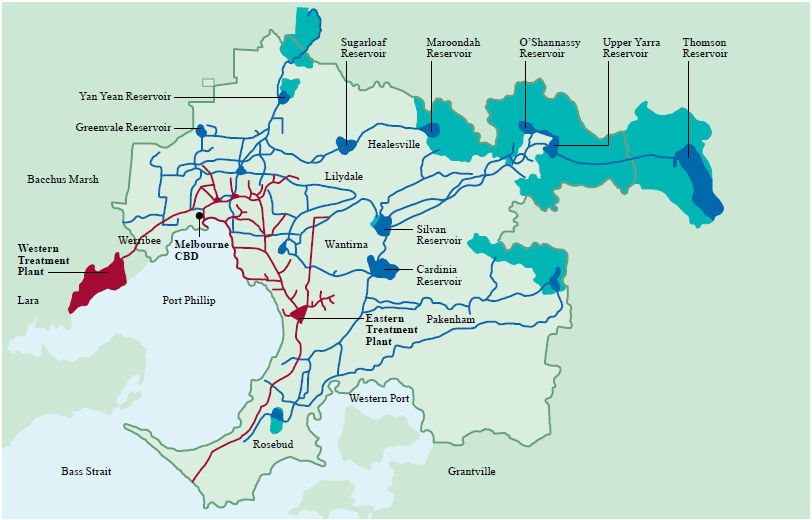
Figure 68 shows Melbourne Water's supply network of catchments, water supply systems, wastewater systems, recycled water supply and transmission, and drainage assets.
Figure 68: Melbourne Water major supply systems
| |||
|
|
|
|
 Water Supply Catchment
 Water Pipelines
 MW Drainage Metro Boundary
 Main Sewer Pipelines
Source: Melbourne Water (2014)
As outlined in Melbourne's Water Future,345 Melbourne has been progressing towards a more holistic, whole-of-water cycle approach to water planning. Melbourne's water system faces a number of pressures that will steadily increase as a growing population consumes more water, discharges more wastewater and increases the intensity of the city's stormwater runoff through the construction of more hard surfaces. The city is growing quickly and is expected to continue to do so for the foreseeable future. Much of this growth will occur in the west and north, where traditional water system delivery is more difficult and expensive.
Managing supply and demand in the future will rely heavily on the desalination plant, and also on integrated water cycle planning and management. The Victorian Government has not ordered water for 2014-15 from the desalination plant, and the plant is now being maintained in long-term preservation mode. Ongoing operation of the plant and the whole-of-water cycle system will incur a significant operating cost, which will have an impact on water charges.
Melbourne's Water Future also acknowledges that a 'one size fits all' approach will not deliver the best outcomes at the lowest cost. The whole of system approach will inform the development and publication of a new water cycle planning framework for metropolitan Melbourne. It will include an outline of current and future required citywide infrastructure, guidelines for regional and local planning and overall pricing principles for the system.
___________________________________________________________________________________________________
344. Melbourne Water (2014)
345. Office of Living Victoria (2013)